
How AI Is Changing Education in the UK in 2026

Owais Bagwan
Consultant
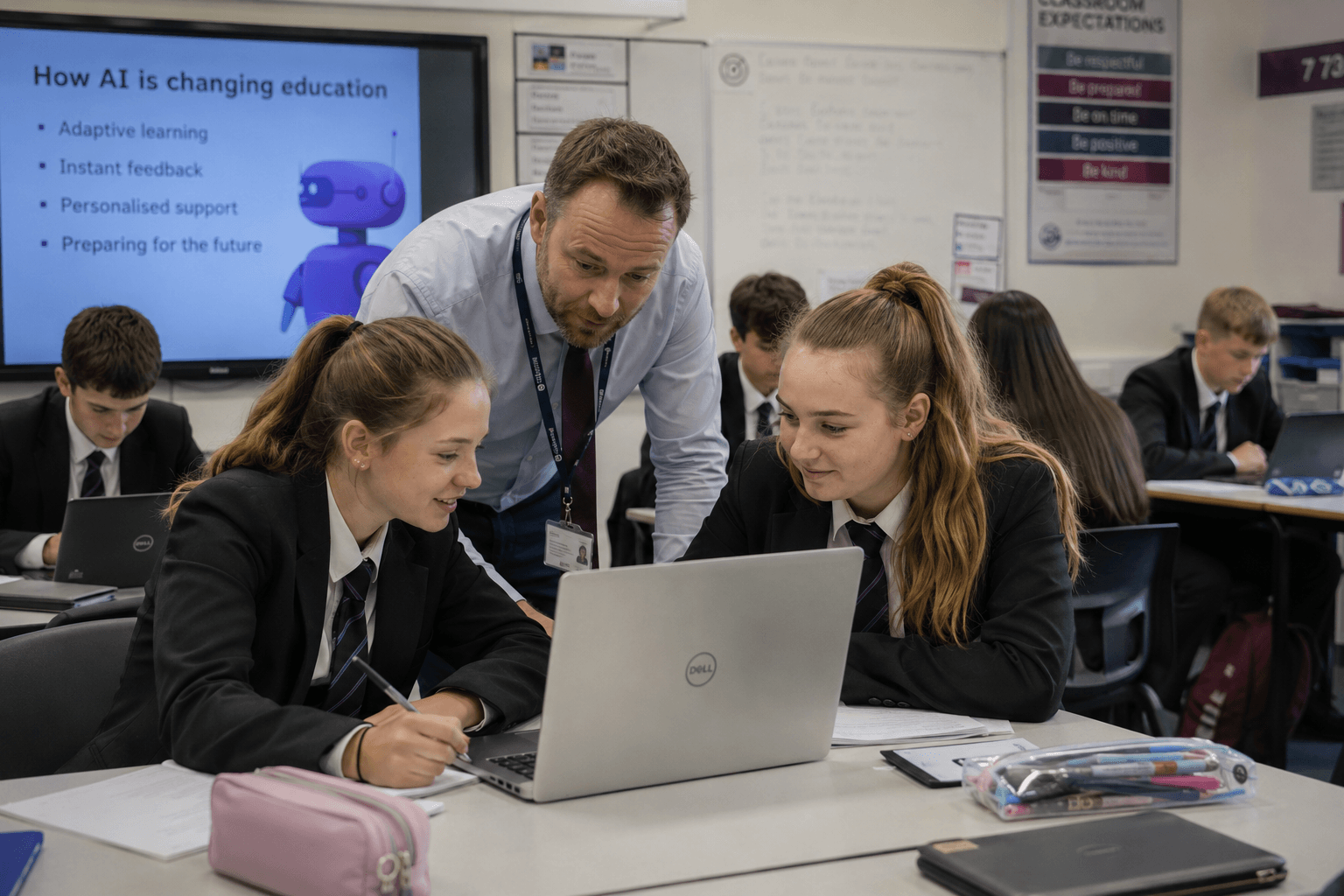
A few years ago, conversations about AI in education tended to be speculative. What might AI do to schools? How might it change teaching? When would it arrive in UK classrooms?
Those questions have been answered. AI is already in UK schools, in various forms, to varying degrees of intentionality. Three quarters of teachers in England now use AI tools for their day-to-day work. [1] Many students are using AI for homework without their school having any policy on it. The government has announced plans to use AI tutoring to support hundreds of thousands of disadvantaged pupils. [2] The technology has moved from conversation to practice faster than most schools, parents, or policymakers were prepared for.
This piece is an overview of where things actually stand in 2026: what AI is doing in UK education, what it means for students and teachers, what the policy landscape looks like, and what parents need to understand about a shift that is already under way in their children’s schools.
Where AI has arrived first: teacher workflow
The most widespread use of AI in UK education right now is not in direct student learning. It is in how teachers do their work.
A survey of over 10,000 teachers in English state schools conducted by the National Education Union in February 2026 found that 76% now use AI tools for day-to-day work, up from 53% the year before. [1] The Pearson School Report 2025, drawing on more than 14,000 respondents from across the UK education landscape, found that 44% of teachers say AI saves them time, particularly in lesson planning and administration. [3]
The most common applications teachers describe are: generating first drafts of lesson plans, producing differentiated resource variants for different ability groups, creating quiz questions and practice materials, and drafting communications to parents and carers. Teachers who use AI tools regularly report saving between one and five hours a week on tasks that used to require significant manual effort. [4]
This matters for a straightforward reason. Secondary school teaching in England is an extraordinarily time-pressured profession. The DfE’s Working Lives survey found that full-time secondary teachers work an average of 49.3 hours a week, with only 26% saying their workload feels acceptable. [5] Any tool that reduces the administrative burden without compromising quality has a genuine case to make, and the evidence from teacher self-reporting suggests AI is making it.
What this means in practice: When your child’s teacher uses AI, it is most likely to help them prepare lessons, generate materials, or handle admin more efficiently. AI is not replacing teachers in UK classrooms. It is helping teachers spend more of their time on the parts of their job that require human judgement. |
How AI is changing how students learn
The shift in student learning is less uniform and harder to characterise than the teacher workflow story, because it is happening in two very different ways simultaneously.
The first is structured and school-led: adaptive learning platforms that adjust the content, pace, and difficulty of what each student practises based on how they are performing. These systems work by monitoring every interaction — every question answered, every error made — and building a picture of what each student knows and where they have gaps. They then adjust the learning pathway accordingly. A student who has mastered fractions is directed towards ratio and proportion. A student who has gaps in fraction understanding stays with that content until they are ready to move forward.
The second way students are using AI is unstructured and largely self-directed: using general-purpose tools like ChatGPT to explain topics, generate essay plans, check answers, or complete work. This is widespread. The Tony Blair Institute’s Generation Ready report, published in January 2026, found that by late 2024 nearly four in ten secondary pupils reported using generative AI tools outside any school-related context. [6] Most are doing so without any guidance from their school on how to use these tools effectively or responsibly.
The difference between these two uses is significant. Structured adaptive learning is designed to build knowledge and identify gaps, with teacher oversight built in. Unstructured student AI use can be valuable or it can undermine the cognitive work that produces learning, depending entirely on how it is being used. The National Education Union’s 2026 survey found that two thirds of secondary teachers have observed a decline in independent thinking among pupils who use AI. [1] That finding deserves attention, not as a reason to ban AI, but as a reason to take the question of how students use it much more seriously than most schools currently do.
The policy picture: where the government stands
The Department for Education published its definitive guidance on generative AI in education in June 2025, updated in August 2025. [7] The guidance is non-statutory but sets clear expectations. Personal data must remain within the school or trust’s organisational boundary. Suppliers must provide documentation on the limitations of their tools. Safeguarding must be designed into AI products used with students. Copyright in student work must be protected.
In January 2026, the government announced plans to develop AI tutoring tools specifically for up to 450,000 disadvantaged pupils, positioning AI tutoring as a potential response to the gap left by the end of the National Tutoring Programme in August 2024. [2] The announcement was met with cautious support from some quarters and scepticism from others, including the National Education Union, whose survey found that 49% of secondary teachers oppose the plan and only 14% are in agreement. [1]
The UK also hosted an international AI in Education Summit in 2026, bringing together education leaders from multiple countries to develop shared frameworks for responsible AI use in schools. The direction of travel at government level is toward greater structure and oversight. The gap between that intention and current school-level practice, where nearly half of schools still have no AI policy at all, remains significant. [1]
A question worth asking the school: Does your child’s school have an AI policy? Both for staff use and for student use? If the answer is no, or unclear, it is a reasonable question to raise at parents’ evening or through the school’s governance channels. The DfE has made clear that schools should have frameworks in place. Many still do not. |
What AI does well in education and where the limits are
AI has genuinely useful applications in education, and it has limitations that are sometimes glossed over in the enthusiasm to adopt. Being clear about both matters.
Where AI is strongest: personalisation and immediate feedback
Well-designed adaptive learning systems can maintain a current, detailed picture of what each student knows across a curriculum in a way that is simply not feasible for a single teacher managing 30 students. They can present content at the right level of difficulty, surface gaps before they compound, and provide immediate feedback at the point of error, when it is most useful. These are genuine improvements on the fixed-pace, one-size-fits-all model that characterises most classroom instruction.
Where AI reduces friction: administration and planning
The time savings AI tools offer teachers in planning, resource creation, and administrative tasks are real and, in a profession under significant workload pressure, meaningful. This is the area where the evidence of benefit is most consistent and the risks are most manageable, because a teacher with professional judgement is reviewing and editing AI outputs rather than presenting them unfiltered to students.
Where the limits are: relationship, motivation, and human judgement
AI systems cannot replicate the relationship between a teacher and a student. They cannot notice that a student who usually participates is unusually withdrawn. They cannot adapt to the emotional state of a room, or make a judgement call about when to push and when to ease off. They cannot provide the kind of mentor relationship that influences a student’s relationship with learning over years rather than sessions. These are not gaps that will be closed by better technology. They are intrinsic to what teaching is.
The honest position on AI in education is that it amplifies what is already there. Schools with strong teaching, clear curriculum, and good pastoral support will find AI useful. Schools without those foundations will not find that AI provides them.
What parents need to know
For parents, the AI question in education is partly practical and partly cultural. Practically, there are things worth finding out and things worth discussing at home. Culturally, it is worth approaching AI in your child’s education with the same combination of openness and critical thinking you would bring to any significant change in how they are learning.
The most useful practical step is finding out what your child’s school’s AI policy actually says. Is there one? Does it cover both staff use and student use? Does your child know what they are and aren’t permitted to use AI for in their schoolwork? The DfE has published guidance that schools are expected to follow, and parents are entitled to ask whether their school has done so.
At home, the most useful conversation is not about banning AI but about how your child is using it. Is it helping them understand something they couldn’t work through alone? Or is it doing the thinking for them in a way that means they are not building the skills the work was designed to develop? The same tool can be either, depending entirely on how it is being used.
The Tony Blair Institute’s 2026 report found that only one in five state secondary teachers explicitly teach students how AI works and what its limitations are. [6] Most students are forming their own habits of AI use without structured guidance. Knowing that, a conversation at home about what AI does and doesn’t do well is not overreach. It is a gap that somebody needs to fill.
What the evidence says so far
The research on AI in education is growing rapidly and is broadly positive, but it is worth being precise about what it shows and what it doesn’t.
The strongest evidence is for AI tools used to support teacher workflow: the time savings are real, consistent, and relatively low-risk, because professional judgement is applied to AI outputs. The evidence for AI as a direct driver of improved student learning outcomes is more limited and more variable. Most high-quality research has been conducted in higher education rather than secondary schools, and the conditions under which adaptive platforms improve outcomes in KS3 and KS4 specifically are still being established.
What the research does consistently show is that the format of instruction matters enormously, and that approaches which adapt to individual learners, provide timely feedback, and support retrieval practice outperform fixed-pace, passive instruction. AI’s potential in education is real because it can, at scale, do things that improve learning outcomes when implemented well. Whether it does so in any given school, for any given student, depends on how thoughtfully it is being used.
Where this leaves schools, parents, and students
AI in education is not a future question. It is a present one, and the decisions being made now, by schools, by government, and by individual families, will shape how it develops. Schools that have engaged with it deliberately, built policies, trained staff, and thought carefully about where it helps and where it risks undermining learning, are in a better position than those that haven’t. Parents who understand what their children’s schools are doing with AI, and who can talk about it at home, are better placed than those for whom it is entirely opaque.
The technology will continue to develop. The underlying questions, about what good learning looks like, who has access to personalised support, and what skills students need to develop without AI doing the work for them, will not change. Those are the questions worth keeping at the centre.
BrainStrata is built on adaptive learning principles aligned with current DfE guidance on AI in education, covering the UK curriculum from KS1 to KS4 with teacher oversight at the centre of its design. Find out more at brainstrata.com.
Sources and further reading
[1] National Education Union (April 2026). State of Education: AI. Online survey of 10,311 teachers in English state schools, conducted 5-16 February 2026. Figures cited: 76% of teachers use AI tools (up from 53%); 49% of schools have no AI policy; 49% of secondary teachers oppose government AI tutor plans; two thirds of secondary teachers observe declining independent thinking in AI-using students. Available at: neu.org.uk
[2] UK Government / Department for Education (January 2026). Government announces AI tutoring programme for up to 450,000 disadvantaged pupils. Reported by BBC News and The Guardian, January 2026.
[3] Pearson (December 2025). Pearson School Report 2025. Survey of 14,000+ voices across the UK education landscape. 44% of teachers reporting AI saves time, particularly in planning and admin. Available at: pearson.com
[4] ResultSense (April 2026). 60% of UK Teachers Use AI But Confidence Lags Behind. Regular AI users saving 1-5 hours weekly on administrative and planning tasks. Available at: resultsense.com
[5] Department for Education (November 2025). Working Lives of Teachers and Leaders: Wave 4. IFF Research and UCL Institute of Education. Full-time secondary teachers working an average of 49.3 hours per week; 26% finding workload acceptable.
[6] Tony Blair Institute for Global Change (January 2026). Generation Ready: Scaling Safe, High-Quality AI in England’s Schools. Citing Teacher Tapp survey of 7,817 teachers (July 2025): one in five state secondary teachers teach students how AI works. Near four in ten secondary pupils using generative AI outside school context by late 2024. Available at: institute.global
[7] Department for Education (June 2025; updated August 2025). Generative Artificial Intelligence in Education: Policy Guidance. Sets non-statutory expectations for AI in schools including data residency, safeguarding-by-design, and copyright. Available at: gov.uk
Frequently asked questions
AI is being used in UK schools in two main ways. The first is teacher workflow: lesson planning, generating differentiated resources, producing quiz questions, and handling administrative tasks more efficiently. A February 2026 survey of over 10,000 teachers found 76% now use AI tools for day-to-day work. The second is in student learning, either through structured adaptive learning platforms that adjust to individual students’ knowledge and gaps, or through students using general-purpose AI tools like ChatGPT independently for homework and study. The second category is widespread but often unguided, as nearly half of schools in England still have no AI policy for student use.
Ready to boost your GCSE results?
Join thousands of students using BrainStrata's AI-powered personalised learning to master their KS3 and KS4 curriculum.
.png)