Differentiated Learning Without Burning Out: A Realistic Teacher's Guide

Owais Bagwan
Consultant
Differentiation is one of those words that tends to produce a particular kind of tired expression in staffrooms. You know you're supposed to do it. You've been told in CPD sessions that every lesson should be adapted to meet every learner's needs. You've seen the Ofsted framework reference it. And you've also got 28 students, a scheme of work to get through, marking from last week still unfinished, and exactly 48 minutes to make something useful happen.
The problem isn't that differentiation is a bad idea. The problem is that it's usually presented as a lesson-planning exercise rather than a teaching habit — which means it either gets bolt-on tasks that take hours to prepare and nobody uses, or it gets ignored entirely because the workload is already at capacity.
The DfE's Working Lives of Teachers and Leaders survey (2025) found that secondary teachers worked an average of 49.3 hours a week, and only 26% felt their workload was acceptable. [1] Differentiated instruction is consistently cited in teacher workload research as one of the main sources of work-related stress — not because adapting to learners is wrong, but because the way it's framed asks teachers to do the impossible. [2]
This guide is about reframing it. Differentiation that's sustainable isn't about producing multiple versions of every lesson. It's about building habits and structures that let you respond to the range of needs in your classroom without redesigning your week.
What differentiation actually means, and what it doesn't
Carol Tomlinson, whose work is the most widely cited framework in differentiated instruction, describes it as proactively modifying teaching in response to students' readiness, interests, or learning profiles. [3] The key word is proactively — building flexibility into your approach from the start, rather than creating entirely separate learning experiences for different groups.
What it doesn't mean, despite how it's sometimes presented in teacher training, is 30 different lesson plans, colour-coded ability groups with separate worksheets, or a constant switching of activities to cater for every learning style. The learning styles theory that underpinned a lot of differentiation practice in UK schools for decades — visual, auditory, kinaesthetic — has not held up well under scrutiny, and most researchers in cognitive science no longer consider it a reliable framework for instructional design.
A systematic review of differentiated instruction in secondary schools published in Frontiers in Psychology (2019) found that while differentiation is widely promoted and has theoretical backing, the empirical evidence on its effectiveness in secondary settings is less conclusive than advocates often suggest, and that more research is needed before firm conclusions can be drawn. [4] That's worth knowing — not because differentiation isn't worth doing, but because it means the justification for spending hours on elaborate differentiated materials is weaker than it might appear. The case for simpler, habit-based approaches is correspondingly stronger.
The honest version: The research on differentiated instruction is more mixed than its prominent place in teacher training and Ofsted guidance might suggest. What the evidence does support is that good teaching — clear instruction, well-sequenced content, responsive questioning, and timely feedback — benefits all learners. Many differentiation strategies work precisely because they make that teaching more deliberate, not because they create separate tracks for different groups.
Why the standard model of differentiation is unsustainable
The version of differentiation that most UK secondary teachers were trained to deliver involves identifying different ability groups in a class, producing adapted tasks or resources for each group, and managing multiple streams of activity simultaneously in a 50-minute lesson. For a teacher covering five or six classes a day, that model isn't sustainable — and in most cases, it isn't happening.
What tends to happen instead is one of two things. Either differentiation becomes a performance for observation — tasks get tiered for the lesson that's being watched, then the rest of the week proceeds as normal. Or teachers take on the preparation burden conscientiously, spend Sunday afternoon creating different versions of the same worksheet, and eventually hit the wall that drives a significant proportion of the workforce to consider leaving. The DfE's 2025 survey found that 29% of teachers were considering leaving the state sector within the next 12 months, with high workload cited as the most common factor. [1]
Neither of these outcomes serves students. The first is hollow; the second isn't sustainable long enough to be useful. The question worth asking is not how to do the standard model better, but whether the standard model is the right model at all.
A more realistic approach: differentiation as teaching habit, not planning burden
The shift that makes differentiation sustainable is treating it as a set of in-lesson habits rather than a preparation task. Most of the techniques below require no additional planning time — they're built into how a lesson runs, not added on top of it.
Habit 1: Design tasks that have a low floor and a high ceiling
A low-floor, high-ceiling task is one that every student can enter and that has room to extend naturally without needing a separate 'extension task'. In practice this means designing the core task to be genuinely open — asking students to explain, justify, compare, or apply, rather than reproduce. A question like 'Explain why this answer is wrong' is accessible to everyone and allows the most capable students to demonstrate sophisticated understanding without needing a different question. Creating one good open task is less work than creating three versions of a closed one.
Habit 2: Use questioning to differentiate in real time
Cold calling with differentiated questions — directing harder questions at students who demonstrate readiness, giving more scaffolded questions to those who are struggling — is one of the most effective ways to adapt teaching without any preparation overhead. The planning required is knowing your students and knowing your content, both of which good teachers already do. What makes it deliberate is having a mental model of which students need more challenge and which need more scaffolding, and directing your questioning accordingly as the lesson unfolds.
Habit 3: Build scaffolding in, but make it optional
Scaffolding — sentence starters, worked examples, structured frameworks — is most useful when it's available rather than compulsory. A student who needs support can use it; a student who doesn't can work without it. The practical version of this is having a set of printed sentence starter cards, a word bank on the board, or a structured note-taking framework that students choose to use or not. This requires one preparation step, not thirty. The psychological difference between 'you must use this frame because you're in the lower group' and 'this is here if you need it' is also significant — the latter doesn't signal deficit.
Habit 4: Use formative checks to adapt mid-lesson, not mid-week
A hinge question halfway through a lesson — one question whose answers reveal whether students have understood a concept — lets you make a decision in the room about what happens next. If most students have understood, you move on. If a significant number haven't, you reteach before moving on. This is responsive teaching in its most practical form. It requires no additional preparation, and it's more useful to students than a different worksheet prepared three days in advance.
Habit 5: Differentiate by time and support, not always by task
Giving students different amounts of time on a task, or different levels of support during it, is often more effective than giving them different tasks. Students who finish early can extend their thinking through a follow-up question. Students who need more time can continue while others discuss. Circulating during independent work and spending more time alongside students who are struggling — rather than assigning them a simpler task and leaving them to it — is both more responsive and more dignified.
The table below summarises the preparation burden and potential impact of common differentiation approaches. It's worth being honest about the trade-offs when planning where to invest time.
| Approach | Preparation cost vs classroom impact |
|---|---|
| Multiple tiered worksheets | High preparation cost. Signals ability grouping to students. Impact on learning outcomes is unclear and depends heavily on quality of materials. |
| Low-floor, high-ceiling tasks | Moderate preparation cost — one well-designed task rather than three. Allows natural extension and is more likely to maintain engagement across the range. |
| Differentiated questioning | No additional preparation cost. High real-time impact. Requires classroom knowledge and subject confidence, not new materials. |
| Optional scaffolding (sentence starters, word banks) | Low preparation cost — one set of materials, reusable across lessons. Reduces stigma of support. Easy to adjust based on what students actually use. |
| Hinge questions and mid-lesson adaptation | No preparation cost beyond designing one good question. Responds to what students actually know rather than what you assumed they knew in advance. |
| Flexible grouping by task or support | Low to no preparation cost. Avoids fixed ability labelling. Most effective when groupings change based on formative evidence rather than being set in advance. |
What about students with SEND and EAL needs?
Students with Education, Health and Care plans or significant EAL needs often require adaptations beyond what in-lesson habit-based differentiation can fully address. For these students, the most important thing is that you know what's in their EHCP or language support plan, and that you're applying the reasonable adjustments specified there consistently — which is a legal requirement, not just good practice.
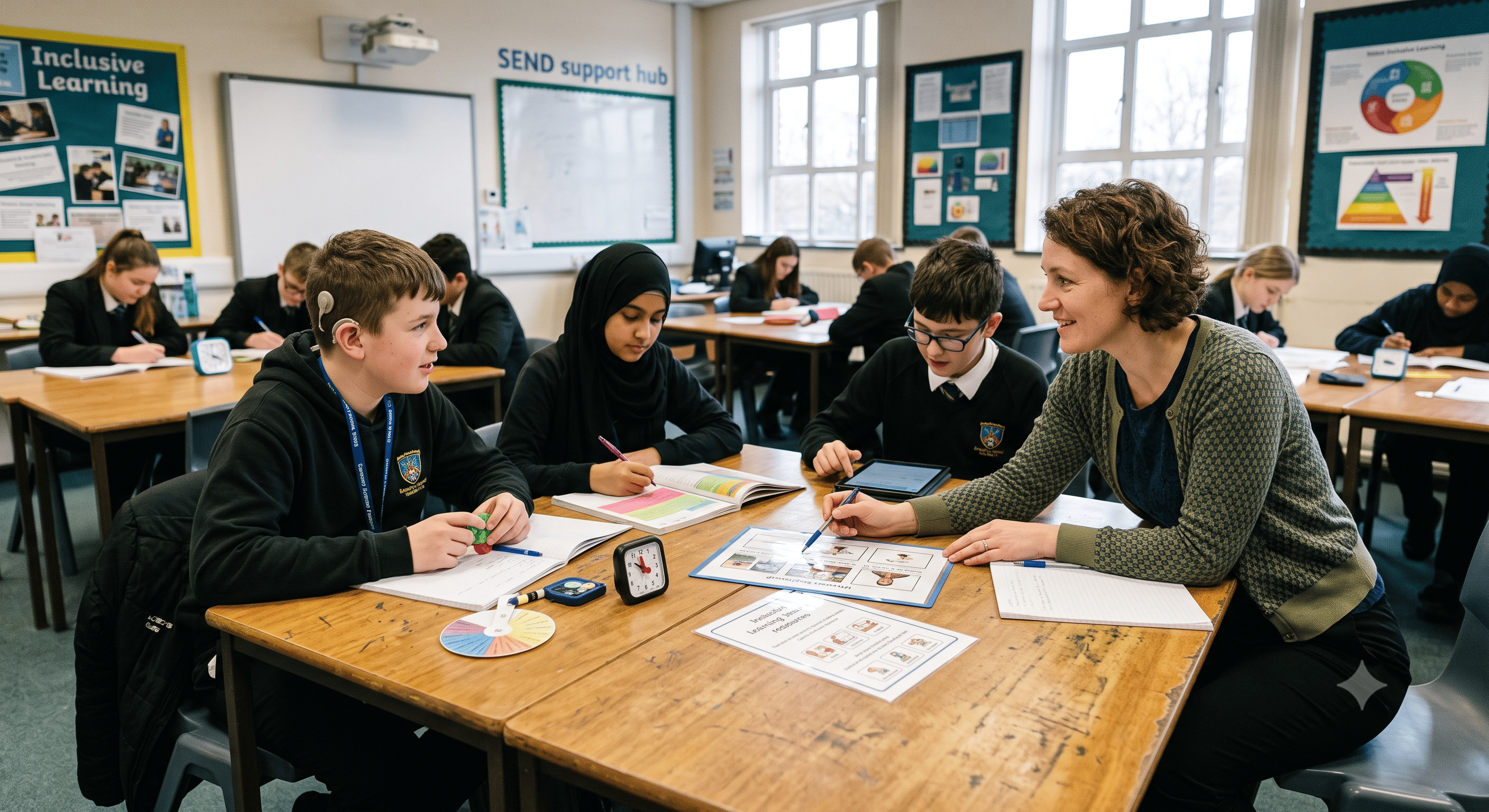
In practice, the most useful adaptations for students with SEND in mainstream secondary classrooms are usually: reducing the processing load of instructions (shorter, clearer, with visual support), allowing extended time on written tasks, providing a structured framework for longer pieces of writing, and making it easy to ask for clarification without drawing attention. These overlap heavily with the general habits described above — the difference is that for students with significant needs, consistency matters more than variety.
For EAL learners, pre-teaching key vocabulary before a lesson, providing a bilingual glossary for technical terms, and pairing students strategically for discussion tasks are adaptations that sit within the same habit-based model and don't require separate lesson planning.
On specialist support: If you have students with significant SEND needs in your class and feel you're not equipped to support them adequately, the first conversation is with your SENCO, not with your planning. Understanding what support is already in place, what reasonable adjustments are legally required, and what resources the school can provide is the starting point — not trying to design a parallel curriculum from scratch.
Differentiation and Ofsted: what inspectors are actually looking for
The Education Inspection Framework doesn't use the word 'differentiation' in the way it was used under previous inspection regimes. Ofsted has been explicit that inspectors are not looking for differentiated worksheets or visible evidence of ability grouping within lessons. What the framework does focus on is whether teaching is responsive to students' needs, whether teachers know what students know, adapt their explanations when students don't understand, and sequence content in a way that builds on prior knowledge.
That's a much closer match to the habit-based model described here than to the tiered-worksheet model. A lesson where the teacher asks good diagnostic questions, reteaches when the hinge question reveals misunderstanding, and provides scaffolding that students choose to use or not will hold up to inspection scrutiny far better than a lesson with colour-coded ability groups and three versions of a handout — and it will take significantly less time to prepare.
Where to start if differentiation has felt unmanageable
Pick one of the habits above and apply it consistently for a half-term before adding another. Differentiated questioning is probably the easiest entry point because it requires the least preparation and gives you immediate feedback on what's working. Low-floor, high-ceiling task design is the highest-leverage change if you want to reduce planning time while increasing the quality of what students do.
It's also worth having an honest departmental conversation about which differentiation practices are actually having an impact and which are being done for compliance. If your department has been producing tiered resources for years and nobody is confident they're making a difference, that's a useful conversation to have — and the research supports having it.
The goal isn't to stop caring about the range of needs in your classroom. It's to find ways of responding to that range that are sustainable enough to maintain over time. A teacher who can differentiate effectively in every lesson across a career is more valuable to students than one who burns out trying to do the impossible version for a term.
BrainStrata supports differentiated learning by adapting to where each student actually is in the curriculum, building personalised learning pathways that can complement your classroom teaching rather than add to your preparation load. Find out more at BrainStrata's adaptive learning platform.
Sources and further reading
[1] Department for Education (2025). Working Lives of Teachers and Leaders: Wave 4. IFF Research and UCL Institute of Education. Published November 2025.
[2] Hulme, M., Beauchamp, G., Wood, J. & Bignell, C. (2024). Teacher Workload Research Report. School of Education and Social Sciences, University of the West of Scotland. Commissioned by the Educational Institute of Scotland. ISBN 978-1-903978-77-1.
[3] Tomlinson, C. A. (2014). The Differentiated Classroom: Responding to the Needs of All Learners (2nd ed.). ASCD.
[4] Smale-Jacobse, A. E. et al. (2019). Differentiated instruction in secondary education: a systematic review of research evidence. Frontiers in Psychology, 10, 2366. DOI: 10.3389/fpsyg.2019.02366
Frequently asked questions
Differentiated learning, also called differentiated instruction, is an approach to teaching that adapts content, process, or expected outcomes based on individual students' readiness, interests, or learning profiles. In practice for secondary teachers, it means building flexibility into lessons so that students with different levels of prior knowledge can all access and progress through the same content, without requiring entirely separate lesson plans for each group.
Ready to boost your GCSE results?
Join thousands of students using BrainStrata's AI-powered personalised learning to master their KS3 and KS4 curriculum.