The Learning Science Every Parent and Teacher Should Know

Owais Bagwan
Consultant
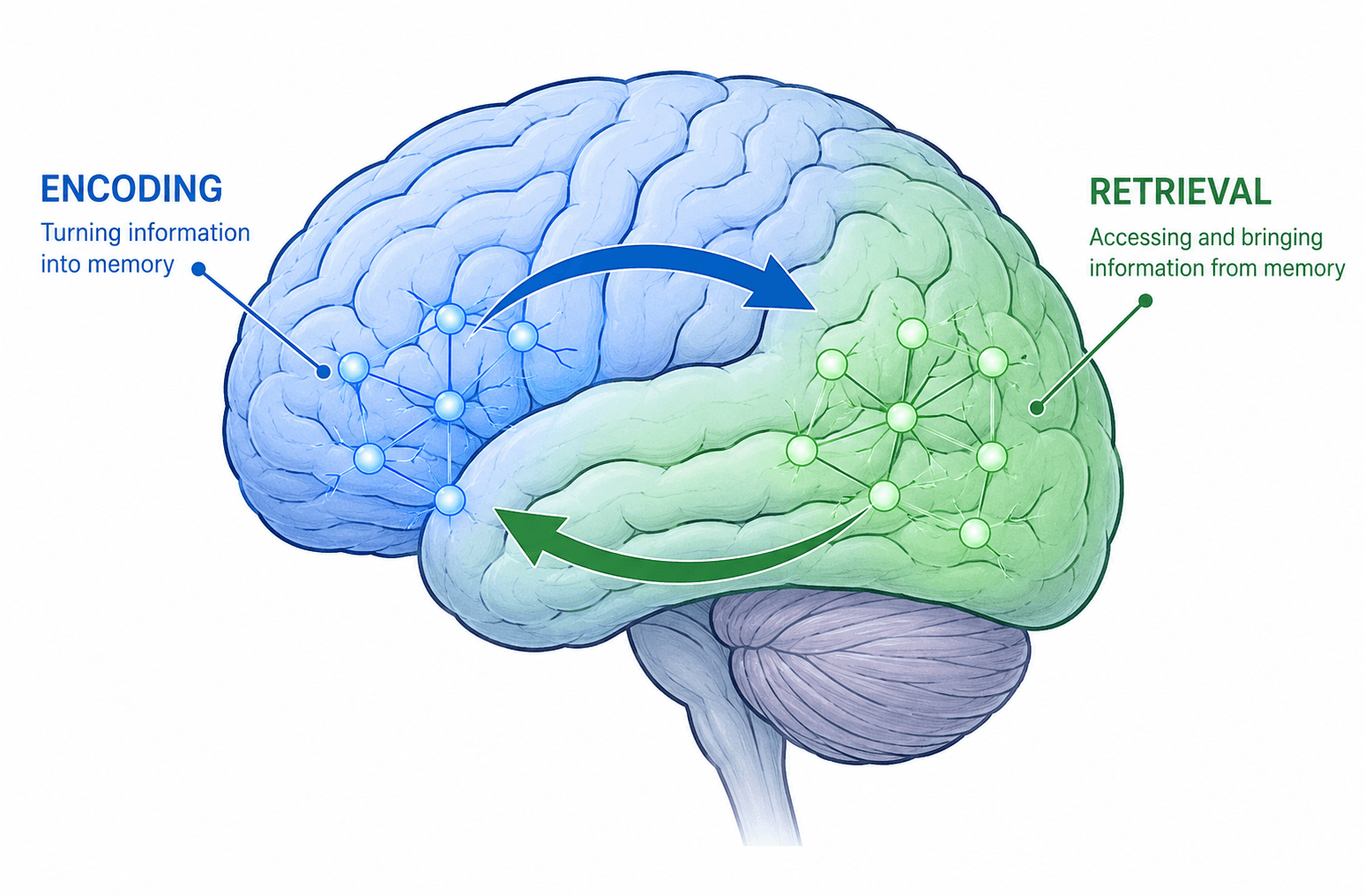
Most advice about revision, homework and classroom practice arrives as a tip. Test yourself instead of rereading. Space your sessions out. Mix your topics up. The tips are usually correct, but they float free of any explanation, which makes them easy to ignore the first time a deadline feels tight.
There is a smaller set of underlying ideas from cognitive science that explains why those tips work, and they are not complicated once unpacked. Four ideas in particular, working memory and cognitive load, spaced repetition, retrieval practice, and desirable difficulty, account for most of what learning science has established about how people actually acquire and retain knowledge. Understanding them changes how a parent responds when a child says a technique feels harder, and how a teacher designs a lesson or a piece of homework.
This is the plain-language version.
Working memory has a very small capacity, and everything starts there
Before anything becomes a lasting memory, it passes through working memory: the mental workspace where information is actively held and processed. Working memory is extremely limited. The classic estimate, from psychologist George Miller's 1956 paper, put its capacity at around seven items. Later research using more precise methods, notably Nelson Cowan's, revised that figure down to closer to four. Either way, the practical point holds: working memory can hold only a handful of things at once, and it forgets what it is holding within seconds unless that information is actively rehearsed or transferred elsewhere.
Long-term memory, by contrast, has effectively unlimited capacity. The entire task of learning is the task of getting information out of the small, temporary working memory and into durable, organised long-term memory, in a form that can be retrieved later. Everything else in this article is really about how that transfer happens, and what helps or hinders it.
Cognitive load theory: why some tasks feel impossible and others don't
Cognitive load theory, developed by educational psychologist John Sweller from 1988 onwards, describes what happens when a task demands more from working memory than it can supply. When that happens, learning stalls, not because the material is too hard in some absolute sense, but because the demand on working memory has exceeded what is available.
Sweller's theory splits this demand into three types. Intrinsic load is the load created by the inherent complexity of the material itself, how many interacting ideas a learner has to hold in mind simultaneously. Some content is intrinsically more demanding than others: simultaneous equations carry more intrinsic load than single-step arithmetic, for a learner meeting each for the first time. Extraneous load is unnecessary load created by how the material is presented, poor formatting, irrelevant decoration, disorganised instructions, that adds nothing to understanding but still consumes working memory capacity. Germane load is the productive load involved in actually building understanding: connecting new information to what is already known, forming what psychologists call a schema.
The practical translation: Reduce extraneous load wherever possible (clear instructions, one task at a time, no unnecessary decoration). Manage intrinsic load by breaking complex material into smaller steps when a learner is new to it. Protect space for germane load, because that is where the actual learning happens. |
A learner with more prior knowledge in a subject has more schemas already built, so material that would overload a novice's working memory fits comfortably for them, because entire chunks of it are already organised and familiar. This is why the same lesson can feel manageable to one student and overwhelming to another sitting next to them: it is rarely about effort. It is about how much of the material each student already has pre-organised in long-term memory.
Spaced repetition: why timing changes what a study session achieves
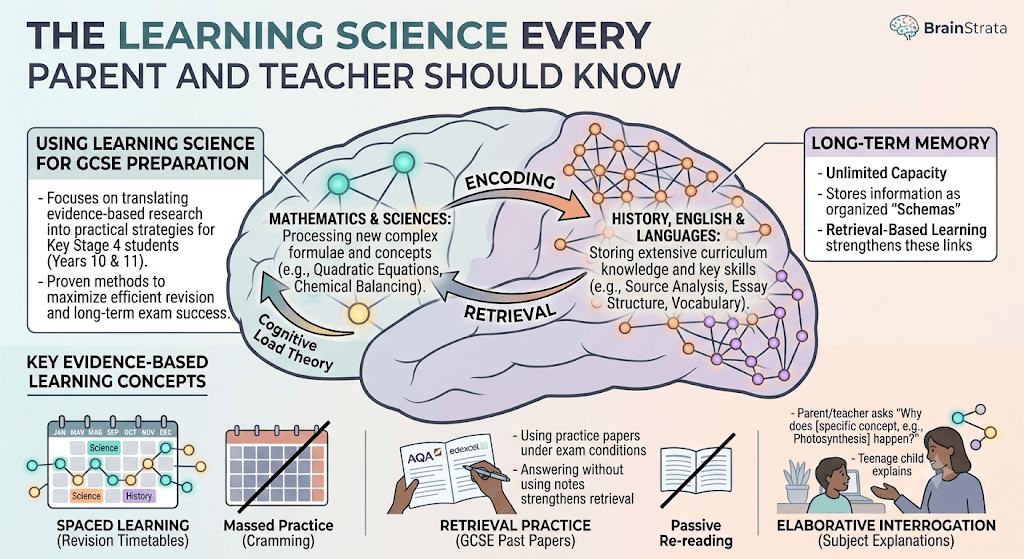
A separate line of research, running for well over a century since Hermann Ebbinghaus's original forgetting-curve experiments in the 1880s, established that the timing of study sessions matters as much as the content within them. Cepeda and colleagues' 2006 meta-analysis, synthesising 184 studies, confirmed the effect at scale: distributing study sessions over time produces significantly stronger long-term retention than concentrating the same total amount of study into a single block.
The mechanism runs through forgetting itself. Each time a memory is allowed to fade slightly before being revisited, retrieving it again requires more effort, and that additional effort is what strengthens the memory for next time. A session that revisits material after it has partially faded builds a stronger memory than a session that revisits material while it is still fresh. This is genuinely counterintuitive: it means the version of revision that feels smoothest and most successful in the moment, going over material again while it is still easy to recall, is often doing the least to build durable memory.
For a parent helping a teenager plan revision, this translates into a specific instruction: do not let a topic sit untouched from one single session until the exam. Build in a return visit, ideally a few days later, then again a week or two after that. For a teacher setting homework, it means a task revisiting material from two or three lessons ago will usually do more for long-term retention than a task on the lesson just taught.
Retrieval practice: testing is not just assessment, it is learning
The single most consistently replicated finding in this field concerns what happens when a learner actively tries to recall information, rather than simply reviewing it. Roediger and Karpicke's foundational 2006 study found that students who tested themselves on material outperformed students who reread it, and the size of that advantage grew larger the longer the delay before the final test.
This has since been confirmed at a scale that leaves little room for doubt. A 2021 meta-analysis by Yang and colleagues pooled 222 classroom studies involving 48,478 students and found that regular low-stakes testing raised academic achievement by an average of close to half a standard deviation, one of the largest effects documented in educational research, achieved through a change in format rather than any additional resource.
The reason retrieval works better than review is that it forces the brain to reconstruct information, rather than simply recognise it on a page. Recognition and reconstruction are different cognitive processes, and only reconstruction reliably strengthens the neural pathways that make later recall possible. A student rereading a page of notes recognises the information as familiar and mistakes that familiarity for knowledge. A student who closes the notes and tries to write down everything they remember discovers, often uncomfortably, how much they had not actually learned.
What this looks like in practice: A parent can ask a child to explain a topic out loud without looking at notes, rather than asking whether they have reread their revision guide. A teacher can open a lesson with a short, low-stakes quiz on material from a previous lesson, rather than a review slide. Both are retrieval, not review, and both do more for long-term memory. |
Desirable difficulty: why the best learning strategies feel worse while they're happening
Psychologist Robert Bjork coined the term desirable difficulty in 1994 to describe a specific and disorienting pattern in the research: the study conditions that feel easiest and most productive in the moment (rereading, massed practice, blocked repetition of a single topic) tend to produce the weakest long-term learning. The conditions that feel harder and less productive (retrieval, spacing, interleaving different topics) tend to produce the strongest long-term learning.
Bjork's explanation rests on a distinction between two properties of a memory: its retrieval strength, how easily it can be accessed right now, and its storage strength, how durably it is embedded for the future. Rereading boosts retrieval strength temporarily, which is why it feels like it is working, but does little for storage strength. Retrieval practice under difficult, effortful conditions does the opposite: it feels less successful in the moment, because recall is harder and more effortful, but it builds storage strength that lasts.
This matters enormously for how parents and teachers interpret a student's discomfort. A student who says a retrieval-based task feels harder than rereading is not wrong. It is harder. That is precisely the mechanism by which it works. The instinct to switch back to something that feels smoother and more successful is understandable, and it is also the instinct that produces weaker long-term learning. Distinguishing a desirable difficulty, one that is productively hard, from an undesirable one, a difficulty caused by confusion, poor instructions, or genuinely missing prior knowledge, is the judgement call at the centre of good teaching and good revision support alike.
Interleaving: why mixing topics beats blocking them
A further, related finding concerns how practice is sequenced across different topics or problem types. When students work through a block of similar problems in a row, performance during practice looks strong, because each problem is a small variation on the one before it. When problems are deliberately mixed across topics, performance during practice looks worse, because the student must first work out which approach applies before attempting a solution.
Rohrer, Dedrick, Hartwig and Cheung's 2020 randomised controlled trial, involving 787 students across 54 classrooms studying mathematics, found the interleaved group significantly outscored the blocked group on a later test, with a large effect size (d = 0.83). The mechanism connects directly to the two ideas above: interleaving is a desirable difficulty, and it works by forcing the retrieval of which strategy to use, not just how to execute it, which is exactly the demand a real exam places on a student.
Putting the four ideas together
These four findings are not four separate tips. They describe a single, coherent picture of how learning actually happens, and each one strengthens the case for the others.
Working memory is limited, so instructional design and revision materials should minimise anything that wastes it on irrelevant processing.
Spacing works because it allows partial forgetting, which makes the next retrieval attempt more effortful and therefore more productive.
Retrieval practice works because reconstructing a memory strengthens it far more than recognising it on a page.
Desirable difficulty explains why the previous two feel counterproductive while they are actually working, and interleaving is one of the clearest examples of a desirable difficulty in practice.
None of this requires additional time, expensive resources, or specialist training to apply. It requires a change in the shape of study and teaching: shorter, harder, more frequent, more spread out, rather than longer, smoother, and concentrated into single sessions.
What this means for parents
The instinct to ask a child whether they have reread their notes is understandable and, according to the research, largely beside the point. A more useful question is whether they can explain the topic without looking, or answer a handful of practice questions from memory. If a revision session feels easy and successful, that is often a signal that too little learning is happening, not too much.
Spacing matters more than most revision timetables account for. A single, long session on a subject the week before an exam produces weaker retention than three shorter sessions on the same subject spread across a month, even though the second approach involves less total study time. A parent who understands this can ask a different, more useful question at home: not how long was your session, but when are you coming back to this topic.
What this means for teachers
Lesson and homework design that reduces extraneous load, clear instructions, uncluttered materials, one demand at a time, frees up working memory capacity for the material that actually matters. Low-stakes retrieval quizzes at the start of lessons, revisiting content from several lessons back rather than the previous one, are one of the highest-impact, lowest-cost interventions available in the entire evidence base on teaching and learning.
Homework and practice sets that interleave question types, rather than blocking a single topic, produce stronger transfer to unfamiliar problems, which is precisely the demand of an exam. And communicating the desirable difficulty concept explicitly to students, so that a harder-feeling task is understood as a sign of real learning rather than a sign of doing something wrong, changes how students respond when a technique like retrieval practice initially feels less successful than rereading.
BrainStrata's adaptive practice model is built directly on these four principles: retrieval-based questions rather than passive content review, spaced review intervals calculated per topic and per student, and interleaved question sequencing across a curriculum, so that the underlying learning science operates automatically in the background of every session, rather than depending on a student or teacher consciously applying it every time.
Frequently asked questions
What is cognitive load theory in simple terms?
Cognitive load theory describes the limits of working memory, the small mental workspace where information is actively processed before it can move into long-term memory. When a task demands more from working memory than a learner has available, whether because the material is inherently complex or because it is presented in a confusing way, learning stalls. The theory was developed by John Sweller from 1988 onwards and remains one of the most influential frameworks in educational psychology.
In practice, it means removing unnecessary complexity from how material is presented (extraneous load), breaking genuinely complex material into smaller steps for learners new to it (intrinsic load), and protecting space for the effortful work of actually connecting new information to existing knowledge (germane load).
What is spaced repetition and why does it work better than cramming?
Spaced repetition means returning to the same material across multiple sessions separated by days or weeks, rather than studying it once in a single concentrated block. A 2006 meta-analysis of 184 studies found that distributing study sessions over time consistently produces stronger long-term retention than massed, single-session study, even when the total amount of study time is identical.
The mechanism is that partial forgetting between sessions makes the next retrieval attempt more effortful, and that additional effort is what strengthens the memory. A single intensive session can feel more successful at the time, but the same material studied across three spaced sessions will be remembered significantly better weeks or months later, which is exactly when a GCSE exam arrives.
What is retrieval practice and how is it different from reviewing notes?
Retrieval practice means actively trying to recall information from memory, through self-testing, practice questions, flashcards, or explaining a topic aloud without notes, rather than passively reviewing material that is already in front of you. A 2021 meta-analysis of 222 classroom studies and 48,478 students found regular low-stakes testing raised academic achievement by close to half a standard deviation, one of the largest effects documented in educational research.
The distinction matters because rereading produces recognition, the sense that information looks familiar, which is easily mistaken for actual learning. Retrieval requires reconstruction, and only reconstruction reliably strengthens the memory pathways that make future recall possible.
What does ‘desirable difficulty’ mean, and why would difficulty ever be a good thing?
Desirable difficulty, a term coined by psychologist Robert Bjork in 1994, describes learning conditions that feel harder and less successful in the moment but produce significantly stronger long-term retention. Spacing, retrieval practice, and interleaving are all examples: each one makes a study session feel less smooth than rereading or blocked repetition, and each one produces better results over time.
The distinction that matters is between a desirable difficulty, one that is productively hard because it forces effortful retrieval, and an undesirable one, a difficulty caused by confusion, poor instructions, or a genuine gap in prior knowledge that needs to be addressed before the task can work. Not all struggle is useful. The struggle involved in trying to recall something you have genuinely studied before is.
Is any of this specific to GCSE students, or does it apply more broadly?
The underlying cognitive mechanisms, working memory capacity, the forgetting curve, the difference between recognition and recall, are not specific to any age group or exam system. The research base spans early primary years through to adult professional learning. What changes with age is the sophistication of the material and the amount of self-direction a learner can reasonably be expected to bring to their own revision.
For GCSE students specifically, the practical relevance is high because the gap between studying a topic and being tested on it in the final exam is often several months, which is exactly the condition under which spacing and retrieval practice show their largest advantages over cramming and rereading.
Sources and further reading
[1] Sweller, J. (1988). Cognitive load during problem solving: Effects on learning. Cognitive Science, 12(2), 257–285. The foundational paper establishing cognitive load theory and the distinction between intrinsic, extraneous and germane load, later refined in Sweller et al. (2019), Educational Psychology Review.
[2] Miller, G. A. (1956). The magical number seven, plus or minus two. Psychological Review, 63(2), 81–97. Cowan, N. (2001). The magical number 4 in short-term memory. Behavioral and Brain Sciences, 24(1), 87–114. Two influential and complementary estimates of working memory capacity.
[3] Cepeda, N. J., Pashler, H., Vul, E., Wixted, J. T., & Rohrer, D. (2006). Distributed practice in verbal recall tasks: A review and quantitative synthesis. Psychological Bulletin, 132(3), 354–380. Meta-analysis of 184 studies confirming spaced practice consistently outperforms massed practice for long-term retention.
[4] Roediger, H. L., & Karpicke, J. D. (2006). Test-enhanced learning: Taking memory tests improves long-term retention. Psychological Science, 17(3), 249–255. The foundational retrieval practice study.
[5] Yang, C., Luo, L., Vadillo, M. A., Yu, R., & Shanks, D. R. (2021). Testing (quizzing) boosts classroom learning: A systematic and meta-analytic review. Psychological Bulletin, 147(4), 399–435. Meta-analysis of 222 classroom studies and 48,478 students confirming the retrieval practice effect at scale (g = 0.499).
[6] Bjork, R. A. (1994). Memory and metamemory considerations in the training of human beings. In Metcalfe, J. & Shimamura, A. (Eds.), Metacognition: Knowing About Knowing (pp. 185–205). MIT Press. Bjork, E. L., & Bjork, R. A. (2011). Making things hard on yourself, but in a good way: Creating desirable difficulties to enhance learning. The original desirable difficulty framework and its most cited follow-up.
[7] Rohrer, D., Dedrick, R. F., Hartwig, M. K., & Cheung, C.-N. (2020). A randomized controlled trial of interleaved mathematics practice. Journal of Educational Psychology, 112(1), 40–52. 787 students, 54 classrooms, d = 0.83 in favour of interleaved practice.
Frequently asked questions
Cognitive load theory describes the limits of working memory, the small mental workspace where information is actively processed before it can move into long-term memory. When a task demands more from working memory than a learner has available, whether because the material is inherently complex or because it is presented in a confusing way, learning stalls. The theory was developed by John Sweller from 1988 onwards and remains one of the most influential frameworks in educational psychology. In practice, it means removing unnecessary complexity from how material is presented (extraneous load), breaking genuinely complex material into smaller steps for learners new to it (intrinsic load), and protecting space for the effortful work of actually connecting new information to existing knowledge (germane load).
Ready to boost your GCSE results?
Join thousands of students using BrainStrata's AI-powered personalised learning to master their KS3 and KS4 curriculum.
.png)