Low-Effort, High-Impact Formative Assessment for Secondary Teachers

Owais Bagwan
Consultant
Most teachers already know, in some general sense, whether a class has understood a lesson. The problem is that the general sense is unreliable, and it tends to be most unreliable for exactly the students who most need it to be accurate. A confident hand up at the front of the room tells you almost nothing about the eleven students who didn't put their hand up.
Formative assessment, the practice of gathering quick, low-stakes evidence of understanding during a lesson rather than after it, is one of the best-evidenced interventions in the entire education research base. Paul Black and Dylan Wiliam's landmark 1998 review of 250 studies found effect sizes between 0.4 and 0.7, among the largest documented for any classroom intervention, with the strongest gains concentrated among lower-attaining students specifically. The Education Endowment Foundation's Teaching and Learning Toolkit rates feedback, closely linked to formative assessment, as worth an average of eight months' additional progress, at very low cost.
None of the techniques below require new resources, extra marking, or a training day. Each one takes under a minute to run inside a lesson that's already planned.
Why this matters more than it might seem to
The core problem formative assessment solves is what Doug Lemov and others have called the illusion of learning: the gap between a class looking like it understands something, nodding along, staying quiet, and a class actually understanding it. Traditional lesson structure, teach a concept, set independent practice, mark it later, means that gap often isn't discovered until books are marked that evening, by which point the lesson has moved on and the misconception has had a full day to settle in.
A randomised controlled trial of the EEF's Embedding Formative Assessment programme, run across 140 secondary schools, found students in participating schools made the equivalent of two additional months' progress in their Attainment 8 GCSE score, with a very high security rating on the result. That's a measurable GCSE-level outcome from a change in how understanding gets checked during lessons, not from any change to curriculum content.
The core techniques
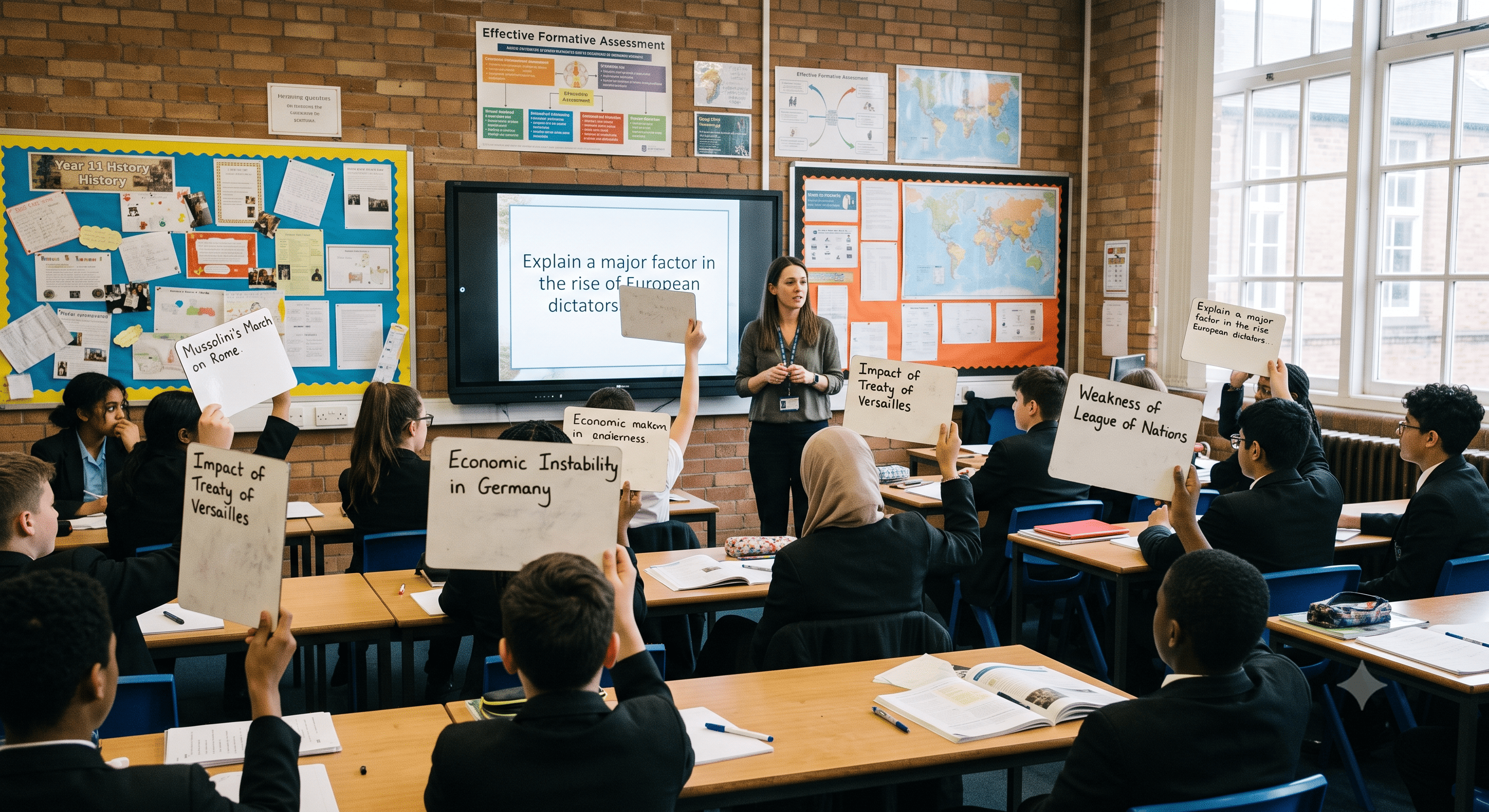
Hinge questions. A hinge question is a single, carefully designed multiple-choice question placed at a specific point in a lesson, the ‘hinge’ on which the rest of the lesson turns. Every student answers simultaneously, using mini whiteboards, ABCD cards or a show of fingers, and the teacher reads the whole class's understanding in the time it takes to scan the room. Dylan Wiliam, who developed the concept, sets a practical constraint: students should be able to answer within one to two minutes, and the teacher should be able to interpret the results within thirty seconds. The design work happens in the wrong answers as much as the right one: each incorrect option should map to a specific, common misconception, so a wrong answer tells you not just that a student is confused, but how.
No hands up. Wiliam has been direct about the standard hands-up approach to questioning: because only around a quarter of students volunteer answers consistently, calling on volunteers tells a teacher almost nothing about the rest of the room, and systematically under-samples exactly the students most likely to be struggling. The alternative is simple: cold-call using lolly sticks, a random name generator, or a seating-plan sweep, so that any student might be asked at any point. This does not need to feel adversarial. Framed consistently as the classroom norm rather than a punishment, it widens the pool of evidence a teacher is working from on every single question.
Mini whiteboards and ABCD cards. The specific tool matters less than the principle behind it: getting every student's answer visible at the same moment, rather than one student's answer at a time. Physicist Eric Mazur's Peer Instruction research, and later work by Beatty and Gerace, found that what matters for formative assessment isn't the technology, whiteboards, clickers, or coloured cards all work, but the simultaneous visibility of every response. A teacher scanning thirty raised whiteboards gets a complete picture of the room in seconds. A teacher waiting for volunteers gets a picture of four or five students, repeated.
A five-minute setup that pays for itself all year: Mini whiteboards, once bought, cost nothing per use and add no marking. The upfront five minutes spent teaching the class the routine, boards up on your call, down and reset in two seconds, is the only implementation cost involved. |
Exit tickets. A short, focused task, often two or three questions, completed in the final few minutes of a lesson and handed in on the way out. Unlike a hinge question, an exit ticket doesn't need to be interpreted instantly; it's designed to inform the start of the next lesson rather than the rest of this one. The discipline that makes exit tickets work is restraint: two or three questions, focused tightly on the lesson's core objective, take under two minutes for students to complete and under ten minutes for a teacher to sort into rough groups, which reliably beats a longer, more thorough check that never actually gets used to plan anything.
Traffic-light self-assessment. Students rate their own confidence in a topic, red, amber or green, using cards, cups, or a simple hand signal. The evidence value here is not in how accurately students judge their own understanding, which varies, but in how quickly it surfaces students who know they're struggling but haven't said so out loud. A student holding up red is providing information no test question could gather as fast: not what they got wrong, but that they already know something is wrong.
Think-pair-share, used diagnostically. The familiar structure, think individually, discuss in pairs, share with the class, becomes formative assessment when a teacher circulates during the pair discussion specifically to listen, rather than to manage behaviour. Paired talk surfaces the reasoning behind an answer in a way a written response often doesn't, and misconceptions tend to surface more honestly in a conversation with a peer than in an answer a student knows the teacher will see.
Live modelling with deliberate errors. A teacher works through a problem on the board and asks students to spot a mistake planted somewhere in the process, either genuinely or on purpose. This inverts the standard flow of a lesson, from teacher demonstrates, students copy, to students evaluate, teacher listens, and it tends to reveal whether students understand the underlying method or have simply been pattern-matching the steps.
The one-word check. At a natural pause in a lesson, ask every student to write, or say to a partner, a single word summarising the concept just covered. It sounds almost too simple to function as assessment, but a room full of accurate, specific one-word answers looks distinctly different from a room full of vague or empty ones, and the check costs seconds rather than minutes.
What makes these different from a test
The distinguishing feature of formative assessment, as Black and Wiliam originally defined it, is not the format of the task but what happens with the information afterward. A test that gets marked, recorded and returned a week later is providing summative information, a snapshot of where a student ended up, regardless of how quick or informal the task itself was. A formative check is one that directly and immediately changes what the teacher does next: reteach a concept, regroup students for paired work, or move on with confidence.
This is also where formative assessment differs from what education researcher Daisy Christodoulou has called the ‘teach, test, move on’ model: a linear structure where understanding is checked only after the unit is finished, by which point reteaching means going back over ground that's already been marked as covered. Formative assessment breaks that model deliberately, checking understanding while there's still a lesson left to adjust, not after the opportunity to adjust has passed.
Making it a habit rather than an event
The techniques above share a structural feature worth naming directly: none require advance preparation beyond planning where in the lesson the check will happen. A hinge question needs writing in advance; a no-hands-up cold-call, a traffic-light check or a one-word summary needs nothing beyond a moment's decision to use it. The upfront cost is almost entirely about building the classroom routine, students knowing what ‘boards up’ means, expecting to be cold-called, understanding that red means something is genuinely wrong, not about the technique itself.
A department that agrees on a shared, consistent set of these routines, rather than each teacher inventing their own, gets a further benefit: students walking into any classroom in that department already know the expectations, and the technique becomes automatic rather than something that has to be explained and re-explained every lesson.
This is also the same underlying diagnostic logic BrainStrata's adaptive practice runs on outside the classroom: gathering evidence of understanding continuously, in small increments, and adjusting what a student sees next in response, rather than waiting for an end-of-unit test to discover a gap that's been sitting there for weeks.
Sources and further reading
[1] Black, P., & Wiliam, D. (1998). Inside the Black Box: Raising Standards Through Classroom Assessment. Phi Delta Kappan, 80(2), 139–148. Landmark synthesis of 250 studies; effect sizes of 0.4 to 0.7 for well-implemented formative assessment, among the largest documented for any educational intervention.
[2] Education Endowment Foundation, Teaching and Learning Toolkit: Feedback (updated guidance). Rated at an average of eight months' additional progress, at very low implementation cost.
[3] Education Endowment Foundation: Embedding Formative Assessment, randomised controlled trial across 140 secondary schools. Students made the equivalent of two additional months' progress in Attainment 8 GCSE score, high security rating.
[4] Wiliam, D., & Leahy, S. (2015). Embedding Formative Assessment: Practical Techniques for K-12 Classrooms. Learning Sciences International. Origin of the hinge question concept and design principles.
[5] Mazur, E. (1997). Peer Instruction: A User's Manual. Prentice Hall. Beatty, I. D., & Gerace, W. J. (2009). Technology-enhanced formative assessment: A research-based pedagogy for teaching science with classroom response technology. Journal of Science Education and Technology. Research on the value of simultaneous whole-class response visibility.
[6] Christodoulou, D. (2017). Making Good Progress? The Future of Assessment for Learning. Oxford University Press. Critique of the ‘teach, test, move on’ model of classroom assessment.
[7] Mercer, N., Wegerif, R., & Dawes, L. (2004), and Mercer, N. (2011), cited in analyses of classroom questioning practice: research on the limitations of volunteer-based (hands up) questioning and its effect on which students are heard.
Frequently asked questions
Summative assessment measures what a student has learned at the end of a period of teaching: an end-of-unit test, a mock exam, a GCSE. Formative assessment gathers evidence of understanding during teaching, specifically so that evidence can change what happens next in the lesson or the following one. The same task, a quiz, for example, can function either way; what determines the category is whether the result changes teaching in real time or simply gets recorded. Black and Wiliam's original 1998 review found formative assessment, properly implemented, produces some of the largest effect sizes documented in education research, between 0.4 and 0.7 standard deviations, notably larger than most other classroom interventions.
Ready to boost your GCSE results?
Join thousands of students using BrainStrata's AI-powered personalised learning to master their KS3 and KS4 curriculum.