7 Signs Your Child Is Struggling at School (and What to Do)

Owais Bagwan
Consultant
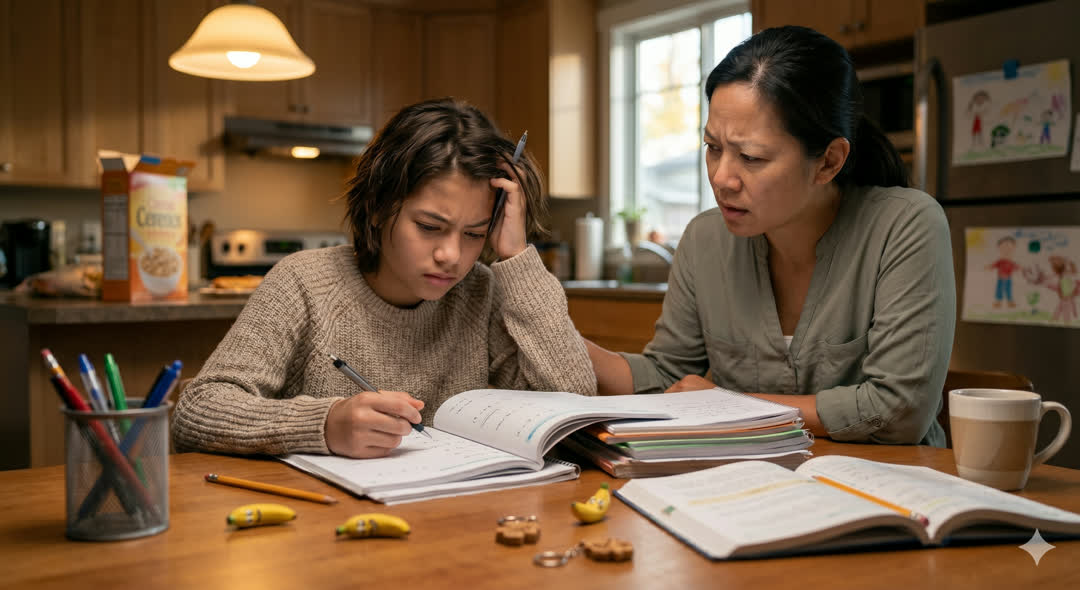
Most parents don't find out their child is struggling in a single dramatic moment. There's no phone call from the school, no obvious breakdown at the kitchen table. What actually happens is quieter than that. Things shift gradually, and by the time you notice, the gap has been growing for weeks.
The tricky part about secondary school is that children are also getting better at hiding things. By Year 8 or 9, most teenagers have figured out how to appear fine. They'll tell you homework is done when it isn't. They'll say a lesson was boring when they actually didn't understand a word of it. And they'll withdraw in ways that are easy to mistake for normal teenage behaviour.
This guide lays out seven of the most common signs that a child is falling behind or starting to struggle, and what you can actually do about each one. These aren't vague red flags. They're specific, recognisable moments that parents describe again and again.
Sign 1: They've stopped talking about school
Think back to Year 5 or 6. Your child probably came home with stories about lessons, teachers, classmates. Now, every question you ask gets a one-word answer. Fine. Good. Nothing.
It's tempting to put this down to adolescence, and sometimes it is. But there's a difference between the selective sharing that comes with growing up and a complete shutdown around the topic of school. When a child goes from occasional updates to total silence, something has usually changed.
The most common reason is embarrassment. Children who are struggling academically often feel ashamed about it, and the easiest way to avoid that feeling is to avoid the subject entirely. They're not being difficult. They're protecting themselves.
What to do:
- Try asking specific questions instead of open ones. 'What did you do in maths today?' gets further than 'How was school?'
- Pick your moment carefully. Car journeys, walks, and mealtimes work better than sitting face-to-face right after school.
- Resist the urge to problem-solve immediately. The goal of the first conversation is to listen, not to fix.
Sign 2: Homework takes much longer than it should, or doesn't get done at all
A Year 9 maths worksheet that should take 25 minutes is taking two hours. Or it's not getting done at all, with increasingly creative explanations why. Both are worth paying attention to.
When homework takes significantly longer than expected, it usually means a child is struggling with the underlying concept, not the task itself. They're not being slow. They're working through something they don't fully understand, one painful line at a time. When homework stops happening altogether, avoidance has set in. And avoidance is almost always a response to anxiety.
A child who can't do the work will often pretend the work doesn't exist. It's easier to say you forgot than to admit you didn't understand.
What to do:
- Set a reasonable time cap on homework with your child. If something is taking far longer than expected, it's worth flagging with the teacher rather than pushing through.
- Ask them to show you where they're getting stuck, not just what they're working on. The sticking point often tells you everything.
- If avoidance has become a pattern, raise it with the school. Teachers are used to these conversations and can usually tell you whether it's a comprehension issue or something else.
Sign 3: Grades have quietly dropped over a term or two
Not a sudden collapse. A gradual slide. A B becoming a C, then a C becoming a D. Perhaps a teacher mentioned in passing that your child 'could do more'. Perhaps you noticed the mark on a returned piece of work and didn't quite register what it meant at the time.
Grade drops over a sustained period are one of the most reliable indicators that a child is struggling with content they didn't fully understand earlier in the year. In secondary school, subjects build on themselves. A shaky understanding of algebra in Year 7 will surface as a real problem in Year 9. A child who missed key concepts during a period of absence or low engagement can find themselves progressively out of their depth without ever having a single 'bad' lesson.
What to do:
- Request a brief meeting with your child's form tutor or subject teacher. Ask specifically whether the drop reflects a comprehension gap or a motivation issue. The approach is different for each.
- Look at the pattern across subjects. A drop in one subject points to a specific content gap. A drop across several subjects often points to something else entirely, such as anxiety, social difficulties, or workload overwhelm.
- If your child is in Year 10 or 11, don't wait for parents' evening. A term's gap is hard to close but still manageable. Two terms becomes significantly harder.
Sign 4: They've gone off a subject they used to enjoy
Your child used to love science. They'd tell you things they'd learned in lessons, ask questions at home, come back with interesting facts. Now they describe it as boring, pointless, or 'too hard'. The switch happened somewhere in the last year.
This is one of the more heartbreaking signs, because it's so often rooted in a single moment of confusion that was never resolved. A concept that didn't land. A lesson they missed. A teacher change that disrupted how they were learning. Children rarely lose interest in subjects they're succeeding at. When enthusiasm drops sharply, confidence has usually gone first.
What to do:
- Ask your child what they last genuinely understood in that subject. This often pinpoints where the gap began.
- Avoid dismissing the subject as boring alongside them. Validating the frustration is useful; reinforcing the disengagement isn't.
- Look for low-stakes ways to rebuild positive exposure to the subject outside of school. A documentary, a podcast, a short YouTube explanation of a concept that's confused them can sometimes reset the relationship with a topic.
Sign 5: Sunday evenings have become difficult
You notice it every week. As Sunday afternoon turns to evening, something shifts. Your child becomes quieter, more irritable, or suddenly remembers five things they should have done over the weekend. The Sunday dread is one of the clearest signs that school has become a place associated with stress rather than learning.
School anxiety in secondary-aged children is far more common than most parents realise. Research from Young Minds found that more than six in ten GCSE students struggle to cope with exam pressure. But anxiety about school doesn't wait for GCSE season. It builds gradually, often starting in Year 8 or 9, and it can affect children who appear perfectly fine on the surface.
Sunday dread isn't bad behaviour. It's anxiety with nowhere else to go.
What to do:
- Don't try to talk them out of the feeling. Telling a child they're worrying about nothing tends to make the worry worse.
- A brief, calm Sunday evening check-in about the week ahead can help. Five minutes going through what's happening each day, noting anything they're nervous about, can reduce the sense of the unknown.
- If Sunday anxiety is affecting sleep, appetite, or family life on a regular basis, it's worth speaking to the school's pastoral lead or your GP. Anxiety responds well to early support.
Sign 6: They compare themselves negatively to classmates
'Everyone else gets it.' 'I'm the only one who can't do this.' 'Mia is so much better at this than me.' Statements like these, repeated and believed, are a sign that your child's academic confidence is in real trouble.
Some comparison between peers is completely normal. But when a child consistently positions themselves at the bottom of every group, when they interpret other people's success as evidence of their own failure, the internal story they're telling about themselves is becoming a problem. Left alone, this kind of thinking makes children less likely to ask for help, less likely to try in class, and less likely to believe that effort will make any difference.
What to do:
- Challenge the all-or-nothing thinking gently. 'Is it really everyone, or does it feel that way right now?' isn't dismissive; it's grounding.
- Shift the comparison point. Progress relative to where your child started, rather than relative to classmates, is a far more useful measure of how they're doing.
- If negative self-talk has become a pattern rather than an occasional frustration, it's worth raising with the school. Pastoral teams are increasingly well-equipped to support this.
Sign 7: They've stopped asking for help
This one surprises parents when they realise it. You'd expect a child who's struggling to ask for more help, not less. But the opposite is often true. A child who's behind, anxious, or ashamed about where they are will frequently retreat into silence because asking for help means admitting they don't understand. And admitting they don't understand feels unbearable.
Teachers notice this too. The children who need the most support are often the quietest in the room. They've learned that raising their hand draws attention to a gap they'd rather keep invisible.
What to do:
- Make it easy to ask for help at home without it feeling like a test. 'Do you want to talk through anything from this week?' is lower stakes than 'Do you understand what you're doing?'
- Praise the act of asking for help, explicitly, when it happens. Children who hear 'That was a good question' learn that not knowing is a starting point, not a verdict.
- If your child isn't accessing support at school, ask the teacher to initiate contact with them rather than waiting for your child to come forward.
What to do if you've recognised several of these signs
Noticing two or three of these signs in your child doesn't mean something is drastically wrong. It does mean it's worth taking seriously before the gap widens.
The single most effective thing you can do in the short term is open a low-pressure conversation with your child about how school is actually feeling for them, not how the grades look, but how they feel. Children who know their parents are on their side rather than waiting to be disappointed tend to open up more quickly than you'd expect.
The next step is getting a clear picture of where the gaps actually are. A conversation with the form tutor or subject teacher will tell you whether the struggle is specific to one topic or more widespread. From there, you can make a plan.
Some children respond well to working through content again at their own pace, away from the pressure of keeping up with a class. Others need someone to work alongside them. Understanding which your child needs is more useful than jumping straight to a solution.
The earlier a gap is spotted, the easier it is to close. Most children who fall behind in secondary school do so gradually. The same is true of catching up.
If you're looking for a way to help your child revisit content at their own pace, BrainStrata is designed for exactly this. It adapts to where each child is, moves at their speed, and covers the UK curriculum from KS1 to KS4. You can start with a free trial of our adaptive learning tools.
Frequently asked questions
The most common signs are a sudden reluctance to talk about school, homework taking much longer than it should or not getting done at all, grades dropping gradually over a term or two, losing interest in a subject they previously enjoyed, Sunday evening anxiety, negative comparisons to classmates, and stopping asking for help. Most of these happen quietly rather than all at once, which is why they're easy to miss.
Ready to boost your GCSE results?
Join thousands of students using BrainStrata's AI-powered personalised learning to master their KS3 and KS4 curriculum.