What Your Teacher Wishes You'd Ask in Class

Owais Bagwan
Consultant
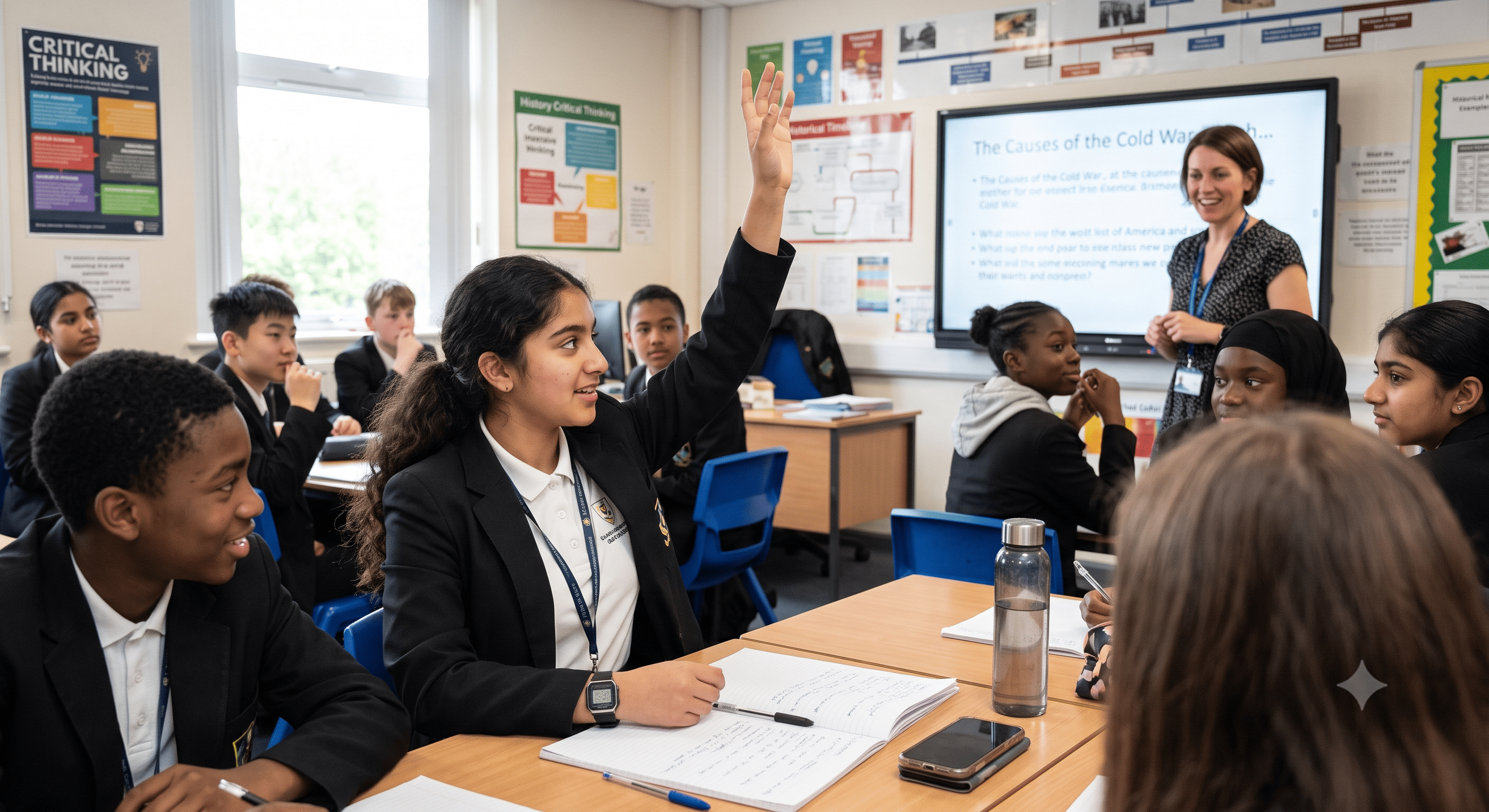
You're stuck on something. Not completely lost, just missing one piece that would make the rest click. Twenty-something other people are in the room, the lesson is moving on, and putting your hand up to say you don't get it feels like the single most exposing thing you could do right now.
So you don't. You write down whatever gets you through the task, plan to figure it out later, and later doesn't come. This happens in classrooms constantly, and here's the part that might actually surprise you: it's usually not the students who are furthest behind doing this. It's often the students who are already doing fine, asking one more question than everyone else, and that's part of why they're doing fine.
Why asking feels so much harder than it should
There's a real, researched reason this feels risky, and it's not just in your head. Educational psychologist Sarah Kiefer, who studies help-seeking in adolescents, describes classrooms at this age as an academic and social minefield at the same time. Every question you ask a teacher in front of the class isn't just an academic move, it's a social one too, and your brain is weighing both at once, whether you're aware of it or not.
There's also a well-documented pattern in how this changes as you get older. A 2012 study by educational psychologist Allison Ryan found that as students move through school, they become steadily less likely to ask a classmate or teacher for genuine help, and more likely to reach for what researchers call ‘expedient help’, copying an answer, glancing at a friend's work, anything that gets the task finished without the exposure of admitting you're stuck. It solves the immediate problem. It does nothing for the actual gap in understanding, which tends to still be there next time the topic comes up.
The surprising research on who actually asks
Here's the finding that reframes most of this. A well-known study by researchers Allison Ryan, Paul Pintrich and Carol Midgley, looking specifically at who avoids seeking help in the classroom and why, found that students who see themselves as low-achieving or less competent are the ones most worried that asking will confirm what they fear, that they're simply not capable. Students who are more confident in their own ability tend to worry about this far less, and are consistently more likely to ask.
This creates a pattern that runs opposite to what feels intuitive. A separate line of research identified something researchers call the passivity effect: as struggling students move through school, they tend to ask fewer questions over time, not more, exactly when they need more input, not less. Meanwhile, the students who already have a solid grip on the material keep asking, keep refining their understanding, and the gap slowly widens, not because of ability, but because of who's willing to put their hand up.
The actual signal a question sends: A specific, well-formed question doesn't signal that you're behind. It signals that you're tracking the lesson closely enough to notice exactly where it stopped making sense. That's a different thing entirely from not following at all, and it's usually read that way by whoever's teaching, even if it doesn't feel that way from where you're sitting. |
Why some questions get you further than others
Not all questions work equally well, and this isn't really about confidence, it's about specificity. Researcher Stuart Karabenick, one of the most cited names in this field, found something worth knowing: in classes where teachers routinely give short, vague answers to genuinely complex questions, students become less likely to keep asking for help over time. The lesson underneath that finding cuts both ways. A vague question (‘I don't get it’) tends to get a vague, unhelpful answer back, which then makes the whole interaction feel like it wasn't worth the risk. A specific question is far more likely to get a specific, useful answer, which makes asking again next time feel worth it.
Five questions that actually get you unstuck
“Can you explain that a different way?” instead of “I don't get it.” This tells your teacher the explanation didn't land, not that the whole topic is a mystery, and it usually gets you a completely different angle on the same idea rather than the same explanation, slightly louder.
“Is this like the thing we did last week with [X]?” Connecting new material to something you already half-understand is one of the fastest ways to build a real mental model, rather than a stack of disconnected facts. It also tends to get a more precise answer, because your teacher now knows exactly where your understanding currently sits.
“What would a wrong answer to this actually look like?” This sounds like an odd question to ask, but it's one of the most useful. Understanding the common mistake, not just the correct method, often makes the correct method make sense in a way a straightforward explanation doesn't.
“Can you check this bit before I finish the rest?” Catching a wrong turn three steps in saves you from redoing an entire piece of work built on the same mistake. This is a completely reasonable thing to ask partway through a task, not just at the end.
“What's the actual mistake here, not just that it's wrong?” When work comes back marked incorrect with no further detail, this question gets you the one thing that actually changes what you do differently next time. ‘Wrong’ tells you nothing useful on its own.
If asking in front of everyone still feels like too much
Not every question needs an audience. Asking at the end of the lesson, in the corridor afterward, or by email later that day gets you the same answer without the class watching, and there's nothing lesser about choosing that route. A lot of teachers actively prefer it, because it gives them a moment to give you a proper answer instead of a rushed one squeezed into the last two minutes of a lesson.
A study group or a reliable friend can also absorb some of this. Saying ‘I didn't get the bit about X, did you?’ to someone sitting next to you carries a fraction of the exposure of asking in front of thirty people, and it very often turns out you weren't the only one who missed it.
This is also part of why BrainStrata's AI Tutor exists the way it does: there's no room of thirty people watching, no risk of the question sounding obvious, and no limit on how many times you can ask it a different way until it actually clicks. It's built for exactly the moment covered in this article, when you're one small question away from understanding something, and the only thing standing between you and that answer is deciding to ask it.
Sources and further reading
[1] Ryan, A. M., Pintrich, P. R., & Midgley, C. (2001). Avoiding seeking help in the classroom: Who and why? Educational Psychology Review, 13(2), 93-114. Foundational research on why low-achieving and low-confidence students are least likely to seek academic help.
[2] Ryan, A. M. (2012), cited in EdWeek and AFT coverage of adolescent help-seeking research: findings on the shift from genuine help-seeking to ‘expedient’ help (e.g. copying) as students get older.
[3] Kiefer, S. M., University of South Florida, cited in Education Week (2014): research on help-seeking as a simultaneously academic and social process in adolescence.
[4] Karabenick, S. A. Research on classroom help-seeking behaviour, cited in ASCD and Education Week: findings on how vague teacher responses to complex questions reduce future help-seeking.
[5] Good, T. L., Slavings, R. L., Harel, K. H., & Emerson, H. (1987), cited in Karabenick & Knapp (1991): identification of the ‘passivity effect’, the tendency of lower-achieving students to ask fewer questions as they progress through school.
[6] Newman, R. S. (2008), cited in Karabenick & Dembo (2011), Understanding and Facilitating Self-Regulated Help Seeking: framework for the practical questions learners face when deciding what and how to ask.
Frequently asked questions
Because it genuinely involves more than one kind of risk at once. Researcher Sarah Kiefer's work on adolescent help-seeking describes the classroom as both an academic and a social space simultaneously, so a question you ask isn't just being judged on whether it makes sense, it's also being weighed against how it might look to everyone else in the room. That second layer is real, and it's a big part of why this feels harder than it logically should. Knowing that this is a well-documented pattern, not a personal weakness, tends to make it a little easier to push through anyway.
Ready to boost your GCSE results?
Join thousands of students using BrainStrata's AI-powered personalised learning to master their KS3 and KS4 curriculum.