The Year 8 Confidence Cliff: What Parents Need to Know

Owais Bagwan
Consultant
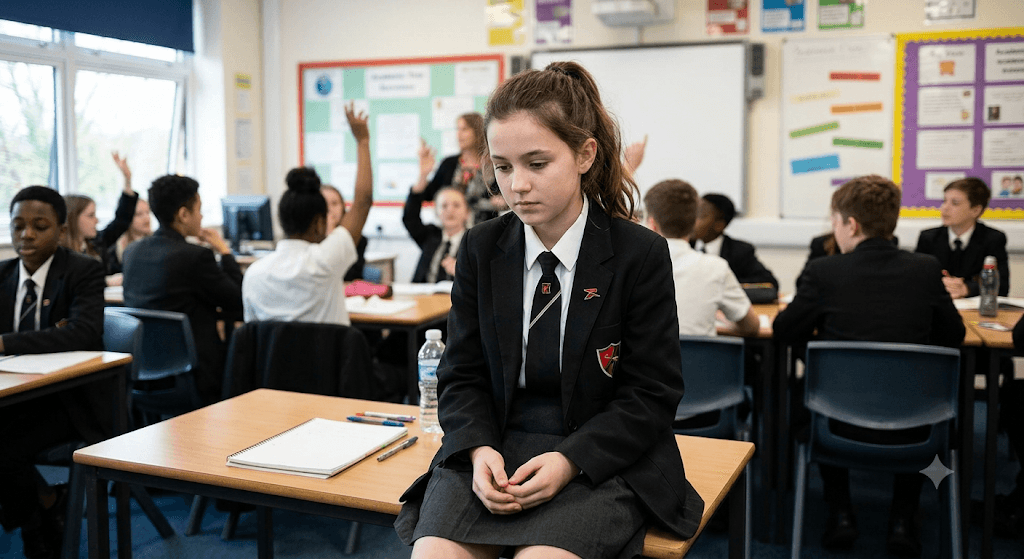
Somewhere around Year 8, a child who used to put their hand up stops putting their hand up. A child who once said maths was their favourite subject starts saying they're ‘just not a maths person’. A child who used to talk about their day starts answering in single words.
None of this tends to arrive as a single moment a parent can point to. There is no argument, no bad report, often not even a bad grade. What changes first is quieter than that: how a child feels about their own ability, well before it shows up in what they achieve.
This has a name in the research literature, though it rarely reaches parents in those terms: academic self-concept, a child's belief about their own competence in a subject. And the evidence on when it drops, how far, and why, is more specific and better documented than most parents realise.
It's a real, measured phenomenon, not a mood
A 2022 longitudinal study published in the International Journal of Environmental Research and Public Health tracked 7,379 students from age nine or ten through to Year 8, measuring academic self-concept at both points. The finding, in the researchers' own words, was that self-concept falls dramatically between primary and secondary school. This was not a study of children who were struggling. It was a study of an ordinary, representative cohort, and the decline showed up across the board, with its size shaped by background factors but its direction consistent almost everywhere.
A separate longitudinal study following students across Grade 5, Grade 6 and into Grade 8 found the same pattern from a different angle: academic engagement and success become, in the researchers' phrase, devalued by peers during this window, and increasingly at odds with a student's social standing. Being visibly good at school, in other words, can start to cost a child something socially, right at the age when social belonging matters more than it ever has before.
What the research is measuring: Not how well a child is doing. How competent they believe they are, independent of their actual grades. The two can move in opposite directions: a child can be doing objectively fine and still be losing confidence in their own ability, and it is the belief, not the grade, that tends to predict what happens to their motivation next. |
Why Year 8 specifically
The transition into secondary school itself, in Year 7, produces a well-documented dip: research reviewed in a 2018 Frontiers in Psychology paper found consistent decreases in academic self-concept, physical self-concept and general self-esteem immediately after the primary-to-secondary transition. But that same review, and the longitudinal data behind it, found something less widely appreciated: self-esteem does not recover once the transition settles. It continues to decline through the years that follow.
This matters for how parents interpret Year 8 specifically. Year 7 is where the shock is visible, new building, new teachers, new social groups, and it gets treated accordingly, with transition programmes, extra pastoral check-ins, a general assumption that some wobble is normal. Year 8 is where the underlying trend continues, quietly, without the obvious cause that made Year 7's dip easy to explain away. A child struggling to settle into a new school is a story that makes sense to parents and teachers alike. A child who has settled in fine but is nonetheless steadily losing confidence in their own ability is a much harder pattern to notice, precisely because nothing dramatic appears to have happened.
Engagement data from England reinforces the same timeline from a different direction. A May 2025 study by ImpactEd Group, ASCL and the Confederation of School Trusts, tracking over 100,000 pupils, found school enjoyment scores fall from around 6.0 out of 10 in Year 6 to 3.8 in Year 7, then fall further still, to 3.2, in Year 8. The drop does not level off after the transition year. It continues.
The mechanism: peer comparison starts to matter more than the teacher's opinion
One of the more specific findings in this area concerns where a child's sense of their own ability actually comes from. Self-efficacy research shows that around ages 12 to 16, precisely the Year 8 to Year 9 window, peers become an increasingly important source of a child's belief in their own competence, a role that in earlier childhood was dominated by parents. Adolescents who spend time with peer groups that are not academically engaged tend to see their own academic self-efficacy decline as a result, independent of their actual performance.
This is a specific and useful thing for a parent to understand: the comparison a Year 8 child is running in their head has shifted. It is no longer primarily ‘what does my teacher think of my work,’ or even ‘what do my parents think.’ It is increasingly ‘how does this compare to what my friends can do, and what they think is worth being good at.’ A child surrounded by peers for whom trying hard in school is not socially valued will often begin to internalise that view, even if nothing about their own ability has changed.
Where this shows up hardest: subject-specific identity
The confidence drop is not evenly distributed across subjects, and the clearest evidence for this comes from research on the gender gap in maths and science confidence. A 2024 YouGov survey of over 1,000 UK pupils aged 11 to 16, commissioned by the education charity Teach First, found that among pupils who said they did not enjoy maths, 54% of girls said they lacked confidence in the subject, compared to 41% of boys. The gap was wider still in science: 43% of girls reported low confidence, against 26% of boys.
What makes this finding matter beyond the gender gap itself is what earlier OECD analysis found sits underneath it. When self-confidence was statistically accounted for, the performance gap between boys and girls in science largely disappeared. Girls who rated themselves as good at science performed, on average, as well as boys who rated themselves the same way. The gap in outcomes was substantially a gap in belief, not a gap in ability.
The identity trap: ‘I'm not good at maths’ is a comment about a bad week. ‘I'm not a maths person’ is an identity. Children in Year 8 are old enough to start forming the second kind of statement, and unlike the first, an identity-level belief tends to shape which choices, subjects and challenges a child avoids for years afterward, not just how they feel about this week's homework. |
Why this window matters more than it looks like it should
A child's academic self-concept at this age is not simply describing where they currently stand. It is actively shaping where they end up. Subject-specific confidence in Year 8 and Year 9 is one of the more consistent predictors of which GCSE options a student pursues, and, further downstream, which A Level and degree subjects they consider realistic for someone like them. A capable student who has quietly decided they are ‘not a science person’ by Year 9 is a student who is unlikely to choose triple science, physics A Level, or an engineering degree, not because they couldn't succeed at any of those, but because the door closed in their own mind years before anyone asked them to choose.
There is also a wellbeing dimension that deserves to be named directly, without overstating it. A large linked education and health record study found that declining educational attainment through secondary school was associated with higher rates of depression in the teenage years, and that a severe decline in attainment specifically distinguished students who went on to self-harm from those who did not. This is not a claim that a confidence dip causes serious mental health difficulty. It is a reminder that how a young person's relationship with school evolves through these years is not a purely academic question, and it is one more reason the Year 8 window deserves real attention rather than being written off as a normal adolescent phase to wait out.
What actually helps
Separate the belief from the evidence. When a child says ‘I'm not a maths person’, that is a belief being stated as a fact. Asking ‘what happened this week that made you feel that way’, rather than either agreeing or arguing the point, keeps the conversation anchored to something specific and changeable, rather than something identity-shaped and fixed.
Notice quietness, not just grades. Because self-concept tends to move before attainment does, a drop in how much a child talks about a subject, volunteers answers, or attempts harder problems is often the earliest available signal, well before it shows up on a report card. A parent who is only checking grades is checking the lagging indicator.
Watch who they're spending time with, and how. Since peer attitudes become a genuine driver of academic self-belief at this age, it is worth paying attention to how a child's friendship group talks about school, effort and ability, not to police the friendship, but to understand one of the real forces shaping how your child sees their own competence right now.
Create small, low-stakes wins in the subject they've written off. Confidence rebuilds through actual, felt competence, not reassurance. A short, achievable success, a few questions answered correctly, a concept that suddenly makes sense, does more to shift a settled belief than being told ‘you're good at this’ in the abstract.
Take the subject-specific pattern seriously, especially with girls in maths and science. If a daughter is expressing low confidence in a subject where she is objectively doing fine, that gap between performance and belief is exactly the pattern the research flags as consequential for later subject choices. It is worth naming directly, rather than assuming it will resolve on its own.
None of this requires waiting for a crisis to act on. The evidence suggests the opposite: this window is precisely when intervention is easiest, because the belief is still forming rather than fully settled. A confidence gap addressed in Year 8 is a conversation. The same gap left until Year 10, once it has shaped two years of subject choices and avoidance, is a much harder thing to unpick.
BrainStrata's adaptive practice is built to create exactly the kind of small, frequent, achievable wins that rebuild subject-specific confidence, meeting a child at the level they're actually at, rather than the level a fixed curriculum assumes, so that competence has room to be felt again before a settled belief has time to take hold.
Sources and further reading
[1] Postigo, Á., Fernández-Alonso, R., Fonseca-Pedrero, E., González-Nuevo, C., & Muñiz, J. (2022). Academic self-concept dramatically declines in secondary school: Personal and contextual determinants. International Journal of Environmental Research and Public Health, 19(5), 3010. Longitudinal study of 7,379 students from age 9-10 to Year 8.
[2] Preckel, F. et al. Self-concept in adolescence: A longitudinal study on reciprocal effects of self-perceptions in academic and social domains. Learning and Instruction. Longitudinal study of 1,282 students across Grade 5, 6 and 8.
[3] Wentzel, K. R., Barry, C. M., & Caldwell, K. A. (2004), cited in reviews of self-efficacy development in adolescence: peer group academic engagement and its association with individual academic self-efficacy from ages 12 to 16.
[4] Review of the Academic and Psychological Impact of the Transition to Secondary Education. Frontiers in Psychology (2018). Synthesis including Schaffhuser et al. (2017) on post-transition decline in self-esteem and academic self-concept.
[5] ImpactEd Group, ASCL and Confederation of School Trusts: Mind the Engagement Gap: A National Study of Pupil Engagement in England's Schools (May 2025). Data from over 100,000 pupils across the 2024-25 academic year.
[6] Teach First / YouGov survey of 1,000+ UK pupils aged 11-16 (November 2023, published February 2024). Gender confidence gap in maths and science.
[7] OECD PISA analysis on gender, confidence and science/maths performance: when self-confidence is statistically controlled for, the gender performance gap substantially narrows or disappears.
[8] School achievement as a predictor of depression and self-harm in adolescence: linked education and health record study. Findings on declining attainment through secondary school and associated mental health outcomes.
Frequently asked questions
Academic self-concept refers to a child's belief about their own competence in a specific school subject, distinct from their actual attainment in that subject and distinct from their general self-esteem. A child can have healthy self-esteem overall while holding a low academic self-concept in one particular subject, most commonly maths or science. This is why a confident, sociable child can still say ‘I'm not a maths person’ with total sincerity. The belief is subject-specific, and it can form and settle independently of how the child feels about themselves more broadly.
Ready to boost your GCSE results?
Join thousands of students using BrainStrata's AI-powered personalised learning to master their KS3 and KS4 curriculum.