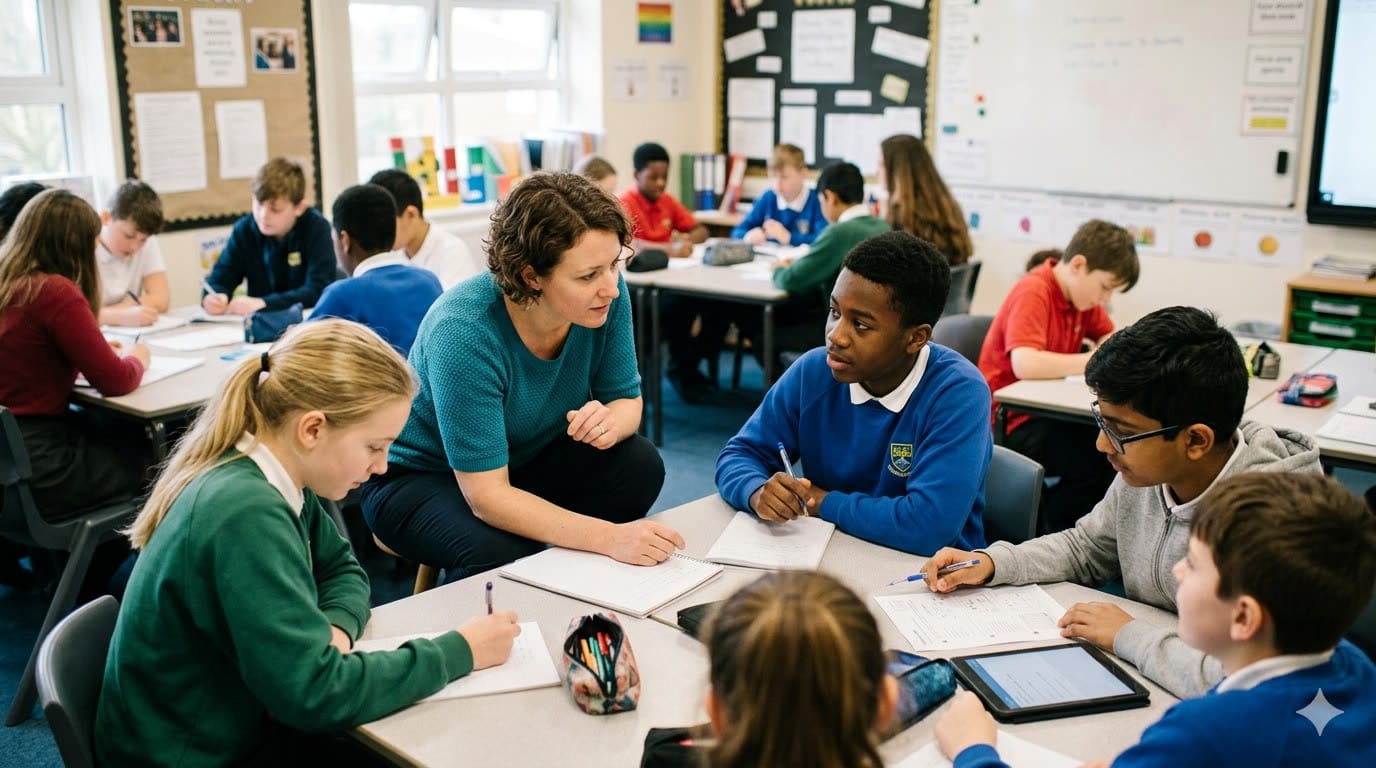
AI in the Classroom: What Actually Works and What's Just Hype

Owais Bagwan
Consultant
The conversation about AI in education has a credibility problem. On one side, vendors and policymakers describe a transformation that is already under way and largely beneficial. On the other, a significant proportion of teachers describe something messier: tools being used without training, students submitting AI-generated work as their own, and a growing sense that critical thinking is quietly eroding.
Both things can be true simultaneously, which is why the honest answer to ‘does AI work in the classroom’ is not yes or no. It depends on what you are using it for, how it is implemented, and whether the school has the infrastructure, policy, and CPD to support it.
This piece does not argue that AI is good or bad for education. It looks at what teachers in the UK are actually doing, what the evidence supports, what is being oversold, and what the specific risks are that are too often glossed over in the enthusiasm to adopt.
Where AI actually is in UK classrooms in 2026
The headline figures on AI adoption in UK schools are striking. A survey of 10,311 teachers in English state schools conducted by the National Education Union in February 2026 found that 76% of teachers now use AI tools for day-to-day work, up from 53% the previous year. [1] A separate Twinkl survey of 6,500 UK teachers in 2025 found 60% using AI technologies for work purposes. [2]
These figures suggest rapid, widespread adoption. But adoption and confident, effective use are not the same thing. The Pearson School Report 2025, drawing on more than 14,000 voices from across the UK education landscape, found that 23% of teachers say they are not confident using AI, and only 9% feel confident teaching it to students. [3] A separate survey found 43% of teachers rating their AI confidence at just 3 out of 10. [4]
The picture that emerges is of a workforce that has moved into daily AI use faster than training and institutional support have kept up. The Department for Education acknowledged in its Technology in Schools Survey (November 2025) that while adoption was accelerating, teachers’ confidence and practical skills were not keeping pace. [5]
The policy situation reflects the same gap. The NEU’s 2026 survey found that 49% of schools have no AI policy whatsoever, either for staff or students, and that 66% of schools have no policy specific to student use — a figure unchanged from 2025. [1] Schools are, in many cases, implementing AI without the frameworks to govern it.
What is genuinely working: the teacher workflow case
The strongest evidence for AI in education right now is not in the classroom. It is in teacher workflow. This distinction matters and is not always made clearly in public debate.
When teachers use AI tools for lesson planning, generating quiz questions, producing differentiated resource variants, summarising feedback, or drafting communication to parents, the time savings are real and the risks are relatively low. The Pearson School Report found 44% of teachers saying AI helps save time, particularly in planning and administration. [3] A ResultSense survey from April 2026 found regular AI users saving between one and five hours weekly on administrative and planning tasks. [4]
These use cases do not require the AI to be right about everything. A teacher who uses an AI tool to generate a first draft of a set of exam questions, then edits them for accuracy and pedagogical fit, is using AI as a productivity tool rather than as an authority. The teacher’s expertise does the important work; the AI handles the time-consuming scaffold.
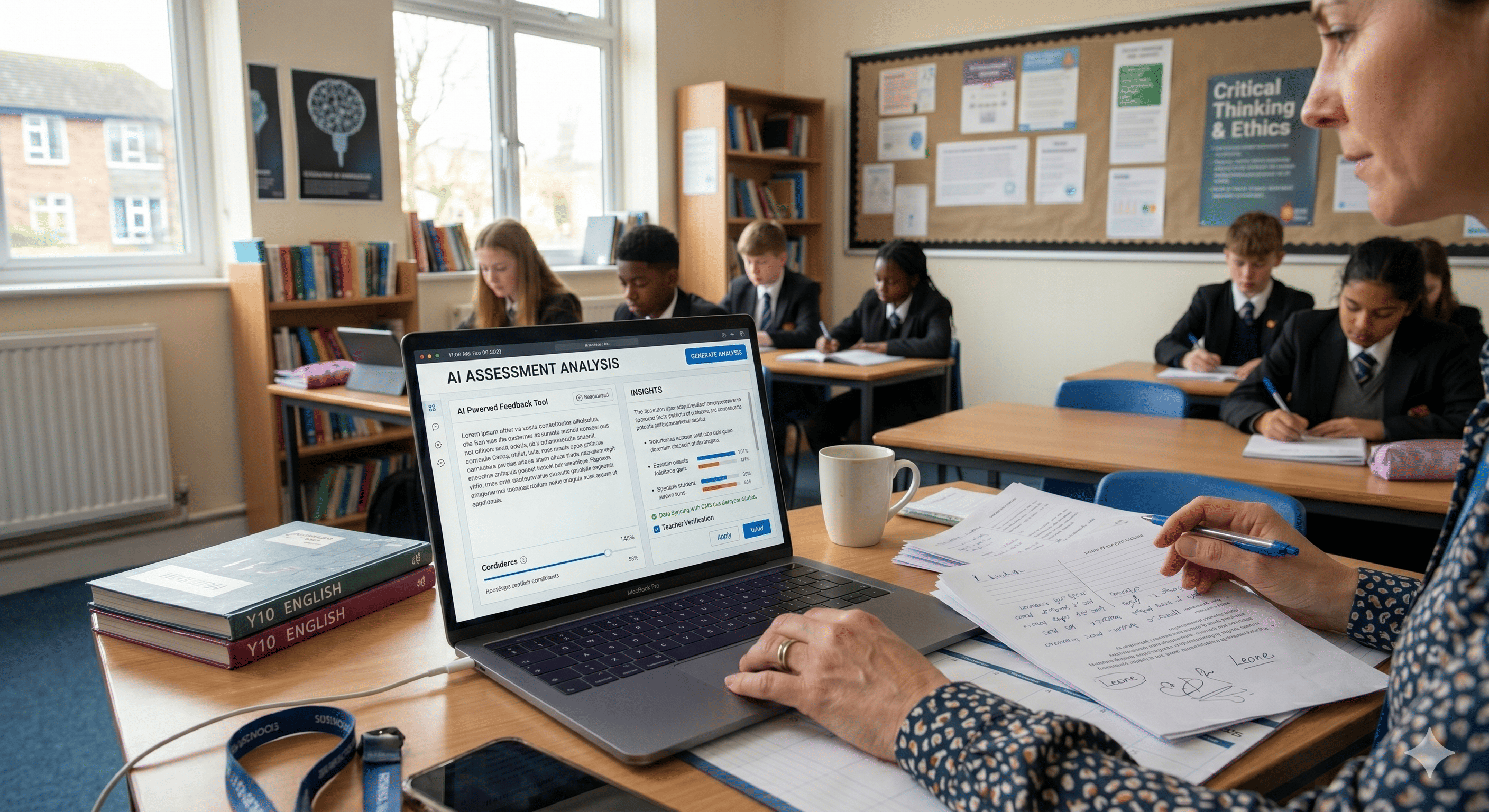
There is also genuine value in how AI tools can support formative feedback. Schools trialling AI-assisted marking — where the system provides an initial response that the teacher then reviews — report useful efficiency gains without removing teacher judgement from the process. The critical design principle in all of these cases is that the teacher remains the decision-maker. AI handles volume; teachers handle quality.
Where the evidence is strongest: AI tools that reduce teacher administrative burden without replacing professional judgement — planning assistance, resource generation, marking support — have the most consistent evidence of genuine benefit. This is not the version of AI in education that generates headlines. It is the version that is making a practical difference to working teachers right now. |
What is being oversold: the AI tutor question
The version of AI in education that attracts the largest claims is AI tutoring: systems that interact directly with students, provide personalised instruction, and are positioned as scalable alternatives to human one-to-one support.
The policy push in this direction is significant. In January 2026, the government announced plans to develop AI tutoring tools to provide one-to-one learning support for up to 450,000 disadvantaged pupils. The Education Secretary described AI tutoring as having ‘the potential to transform access to tailored support.’ [6]
The enthusiasm is understandable. The gap left by the end of the National Tutoring Programme in August 2024 is real, the need for scalable personalised support is real, and well-designed adaptive systems can do genuinely useful things. But the evidence base for AI tutoring specifically — as opposed to adaptive learning platforms more broadly — is not yet strong enough to support the scale of claims being made.
The NEU’s 2026 survey found that 49% of secondary school teachers oppose the government’s AI tutor plans, with only 14% in agreement. Teacher responses in the survey pointed to concerns that are not simply technophobia: students who need tutoring often need more than academic content delivery; they need relationship, motivation, and the kind of responsiveness to emotional state that AI systems cannot currently provide. [1]
A TUC poll from January 2026 found that 80% of parents trust education staff — not AI vendors or government to make decisions about AI in their children’s learning. [7] The credibility of the AI tutor case depends on developing an evidence base that currently does not exist at the scale being claimed.
The signal that is not getting enough attention
The most significant finding from the NEU’s 2026 survey is one that has received relatively little coverage in the wider AI in education debate. Two-thirds of secondary school teachers said they had observed a decline in students’ capacity for independent thinking among pupils who use AI. [1]
This is not a marginal finding from a small sample. It is the professional judgement of more than 9,000 secondary school teachers in England, based on direct classroom observation. The teachers who raised it were not arguing against AI in education. They were flagging a specific, observable pattern: students using AI to complete tasks rather than to support their own thinking, and the consequent atrophying of the skills that underpinned the task in the first place.
The problem is not that AI tools exist. It is that students are using them without guidance, without policy, and without the critical literacy skills needed to use them well. The Tony Blair Institute’s Generation Ready report (January 2026) found that only one in five state secondary teachers teach students how AI works and what it is. [8] Students are, in many cases, encountering and using AI without any structured framework for understanding its limitations.
This is a school leadership and CPD problem as much as a curriculum problem. Schools that have developed clear AI policies for both staff and student use and that provide training rather than simply permitting or banning tools are in a significantly better position than those that haven’t. The 49% of schools with no policy at all are not just unprepared for the risks. They are also leaving their students without the guidance to use AI in ways that actually help them learn.
The honest tension: Students are using AI whether schools have a policy or not. The question is whether they are using it in ways that build their thinking or in ways that substitute for it. That question does not answer itself. It requires deliberate decisions about how AI is introduced, what it is used for, and what teachers are supported to do with it. |
DfE guidance and what it means for schools
The DfE published its definitive generative AI guidance in June 2025, updated in August 2025. The guidance is non-statutory but sets out clear expectations: personal data must stay within the school or trust organisational boundary, suppliers must provide technical documentation on limitations, and schools should ensure AI tools are designed with safeguarding in mind. [5]
For schools evaluating AI tools, this guidance provides a useful baseline checklist. Any platform that cannot clearly answer questions about data residency, copyright, and the human oversight built into its design should not be in use with students. The DfE’s digital standards programme, which sets targets for schools to meet by 2030, places AI readiness within a broader framework of infrastructure and governance that many schools are still working towards.
The UK is also hosting an international AI in Education Summit in 2026, bringing together education leaders to develop shared positions on responsible AI use in schools. The direction of travel at policy level is toward greater structure and oversight, not the laissez-faire adoption that currently characterises most school-level practice.
A practical framework for evaluating AI tools
Given the range of claims made by AI in education vendors, and the mixed state of evidence, it is worth having a consistent framework for evaluating tools before they are introduced to students. The following questions are a useful starting point.
Does it reduce teacher workload: or does it just move it around?
Some AI tools genuinely save preparation time. Others require significant teacher effort to set up, maintain, and verify. Before adopting a tool, it is worth being specific about which tasks it is expected to help with and whether, in practice, it delivers on that for your context.
Is the AI visible to students as AI: or does it obscure its nature?
Tools that present AI-generated content as if it were teacher or peer feedback are harder to use as teaching moments about AI literacy. Tools that are transparent about their AI nature — and that present limitations alongside outputs — are more consistent with the critical literacy goals that most schools would say they care about.
Does it have a DfE-aligned data and safeguarding position: and can the vendor demonstrate it?
The DfE’s June 2025 guidance is the current baseline. If a vendor cannot clearly explain their data residency policy, safeguarding-by-design approach, and copyright position regarding student work, that is disqualifying information.
Is it being used to support learning: or to replace the cognitive work that produces it?
This is the most important question and the hardest to answer without trial and observation. The most reliable indicator is how students interact with the tool: are they using AI outputs as starting points they then develop, or as finished products they submit? Policy, training, and classroom culture all influence the answer.
Where this leaves teachers
AI is not going away, and it is not a problem that can be resolved by banning it or by adopting it uncritically. The teachers who are in the best position right now are not those who have most enthusiastically embraced every new tool, and they are not those who have refused engagement entirely. They are those who have made deliberate choices about where AI genuinely helps, where it introduces risk, and how to ensure students are developing real skills alongside whatever AI support is available.
The hype cycle in education technology has a long history of overclaiming and underdelivering. AI is different in scale and capability from what came before, but the questions worth asking are the same ones that have always mattered: does this make learning better, for which students, under what conditions, and at what cost?
BrainStrata’s adaptive learning platform is built around these principles — transparent about what AI does and doesn’t do, designed with teacher oversight at its centre, and aligned with DfE guidance on data safety and safeguarding. Find out more at brainstrata.com.
Sources and further reading
[1] National Education Union (April 2026). State of Education: AI. Online survey of 10,311 teachers and 2,996 support staff in English state schools, conducted 5-16 February 2026. Available at: neu.org.uk/latest/press-releases/state-education-2026-ai
[2] Twinkl (2025). Survey of 6,500 UK teachers on AI use for work purposes. Cited in: Third Space Learning (2026). AI in Education: What’s Really Happening in UK Schools. Available at: thirdspacelearning.com/blog/ai-in-education
[3] Pearson (December 2025). Pearson School Report 2025. Survey of 14,000+ voices across the UK education landscape. Available via: barchart.com/story/news/36448036 and pearson.com
[4] ResultSense (April 2026). 60% of UK Teachers Use AI But Confidence Lags Behind. Available at: resultsense.com/news/2026-04-13-ai-adoption-in-british-classrooms-outpaces-policy
[5] Department for Education (June 2025; updated August 2025). Generative Artificial Intelligence in Education: Policy guidance. Available at: gov.uk. Also: Technology in Schools Survey Report 2024-25 (November 2025). Available at: gov.uk
[6] UK Government / Department for Education (January 2026). Government announces AI tutoring programme for up to 450,000 disadvantaged pupils. Reported by The Guardian and BBC News, January 2026.
[7] TUC (January 2026). 8 in 10 Parents Trust Education Staff on AI as Unions Set Out Roadmap. Available at: tuc.org.uk/news/8-10-parents-trust-education-staff-ai-unions-set-out-roadmap-tuc
[8] Tony Blair Institute for Global Change (January 2026). Generation Ready: Scaling Safe, High-Quality AI in England’s Schools. Citing Teacher Tapp survey of 7,817 teachers in England, conducted 2 July 2025. Available at: institute.global
Frequently asked questions
The most widespread use cases among UK teachers are in workflow rather than direct teaching: lesson planning, generating quiz questions and resources, producing first drafts of communications, and marking support. A February 2026 NEU survey of over 10,000 teachers found 76% using AI tools for day-to-day work, with the most common applications being administrative and planning tasks. Direct classroom use AI tools interacting with students is growing but less uniform, and the evidence of impact is more mixed. Most schools still do not have clear policies governing how students should use AI, which affects how effectively classroom AI use can be guided.
Ready to boost your GCSE results?
Join thousands of students using BrainStrata's AI-powered personalised learning to master their KS3 and KS4 curriculum.