GCSE Revision: What the Research Says Actually Works

Owais Bagwan
Consultant
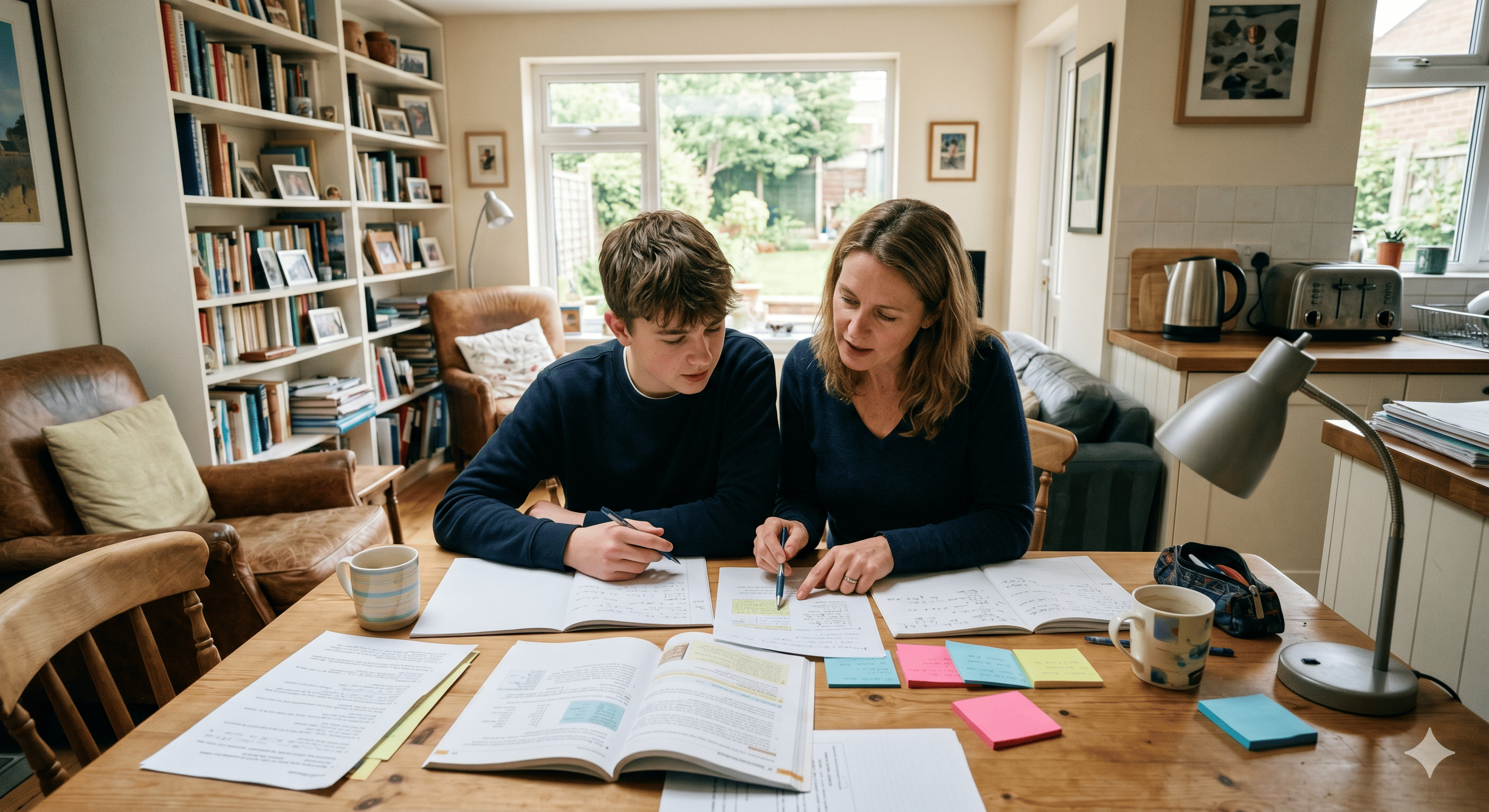
Most parents help their children revise the same way they were helped themselves. You sit with them, go over the notes, maybe quiz them on a few things. You encourage them to read through their textbook before an exam. You suggest they make their revision cards look clear and organised. All of this feels like the right thing to do.
What the research suggests is that most of it builds the wrong kind of memory for what a GCSE exam tests. Not because you’re doing anything wrong, but because almost nobody taught you what effective revision actually looks like and the techniques that feel most like studying are often the ones that produce the least long-term retention.
In 2013, a team of cognitive psychologists led by John Dunlosky published a comprehensive review in Psychological Science in the Public Interest, rating ten of the most common study techniques by how useful they actually are for long-term learning. [1] The results were striking. The techniques students rely on most heavily were rated lowest. The techniques students use least were rated highest.
This piece explains what they found and what it means in practice for any parent trying to help a Year 10 or Year 11 child prepare for their GCSEs.
The ten techniques and how they were rated
Dunlosky and colleagues evaluated each technique across multiple studies, looking at whether the benefits held across different types of learners, different subjects, and different types of assessment. Their ratings are below.
Rating | Technique | What it means |
HIGH | Practice testing | Closing notes and testing yourself from memory — flashcards, past paper questions, blank page recall |
HIGH | Distributed practice | Returning to the same material across multiple sessions, spread over days or weeks |
MODERATE | Elaborative interrogation | Asking and answering ‘why’ questions about the content |
MODERATE | Self-explanation | Explaining how new information connects to what you already know |
MODERATE | Interleaved practice | Mixing topics within a session rather than completing one topic before moving to the next |
LOW | Re-reading | Reading through notes or textbook content again after an initial read |
LOW | Highlighting | Marking text while reading |
LOW | Summarisation | Writing summaries of the material to be learned |
LOW | Keyword mnemonic | Using keywords and mental images to associate verbal material |
LOW | Imagery for text | Forming mental images of text material while reading |
The low-utility rating does not mean these techniques do nothing. Re-reading, for example, improves how quickly your child’s brain processes familiar text. The problem is that processing familiar text quickly is not what an exam tests. An exam tests whether your child can retrieve information without it being in front of them. Re-reading builds the first; it doesn’t build the second.
Why the high-utility techniques work
Practice testing: the most powerful thing your child can do
Practice testing means closing the notes and trying to recall information from memory. This is uncomfortable, and it’s supposed to be. The difficulty of trying to retrieve something that isn’t in front of you is precisely the mechanism that builds lasting memory.
A study by Roediger and Karpicke published in 2006 found that students who tested themselves on material remembered significantly more of it a week later than students who spent the same time re-reading. [2] Students who re-read performed better immediately after the session. Students who used practice testing performed substantially better when tested a week later, when it actually mattered.
For GCSE students, practice testing has a straightforward application: past papers. Every major exam board publishes past papers and mark schemes on their website, and they’re free to download. Sitting a timed past paper under realistic conditions is the closest preparation available to the real exam, and the act of attempting questions before you feel ready is precisely what builds the kind of memory you need under exam pressure.
Something practical to do tonight: Ask your child to put their notes away, take a blank piece of paper, and write down everything they know about one topic from whatever they last revised. No looking. Then check the notes and see what they missed. That gap between what they thought they knew and what they actually recalled is where the revision needs to go next. |
Distributed practice: the spacing effect
Distributed practice means returning to the same material across multiple sessions rather than covering it all in one go. Three 30-minute sessions on the same topic spread across a week builds stronger memory than a single 90-minute session, even when the total time spent is identical. [3]
This matters enormously for how revision timetables are constructed. A timetable that allocates Monday to maths and never returns to it until the exam is not distributed practice. A timetable that revisits each topic two or three times across the revision period, returning to it just as it’s starting to fade, is. The second builds much more durable memory than the first, and it makes better use of whatever time is available.
If your child’s revision timetable is a long list of topics covered once and ticked off, it is worth revisiting it together. The most useful timetables are built backwards from the exam date, with each subject’s most important topics scheduled to appear at least twice.
What parents can do: the 'why' question
One of the moderate-utility techniques in the Dunlosky review is elaborative interrogation. It works by prompting a student to generate an explanation for why something is true, rather than simply memorising that it is. [1] The foundational study, by Pressley and colleagues in 1987, found that students who were asked to explain why facts were true recalled substantially more of them than students who simply read them. [4]
The reason this matters for parents is that it requires no subject knowledge to implement. You don’t need to know anything about photosynthesis or the causes of the First World War to ask: ‘Why is that the case?’ or ‘Can you explain that to me?’ or ‘How does that connect to the bit you told me earlier?’
A parent who asks their child to explain a topic genuinely, in plain language, as if to someone who knows nothing about it is helping them do something more useful than re-reading notes. The child has to retrieve the information from memory, organise it, and find a way to express it. Each of those steps strengthens the memory in a way that reading it again does not.
This is sometimes described informally as the ‘teach it to someone else’ method. The research suggests it works. And it is something any parent can do, regardless of what the subject is.
A script that helps: Try this after any revision session: ‘Okay, explain that to me as if I know nothing about it.’ Let them stumble. Let them realise they can’t quite articulate something they thought they knew. That moment of uncertainty is valuable, it shows them where the gap actually is. |
GCSE-specific: making the most of past papers
Past papers deserve a section of their own because they are underused by most students and are probably the single most important revision resource available for GCSE preparation.
Every exam board — AQA, Edexcel, OCR, and others, publishes past papers and mark schemes on their website, free to download. These papers show exactly how questions are worded, how marks are distributed, and what examiners are looking for. Students who are unfamiliar with the format of their exam papers are at a significant disadvantage, regardless of how well they know the content.
The most useful way to use past papers is not to read through them, but to sit them under timed conditions. A student who has never experienced the pressure of writing for 90 minutes against a clock; managing time across questions, knowing when to move on, dealing with a question that doesn’t look like any they’ve practised will face that experience for the first time in the actual exam. That is not a good time to encounter it.
Mark schemes are equally important. When a student marks their own past paper against the mark scheme, they see exactly where their answer differed from what examiners credit. That information is more actionable than almost any other feedback available to a student at this stage.
If your child is in Year 11 and has not yet done a full past paper under timed conditions in at least one subject, this is the most practical thing that can change in the next week.
The technique that most families overlook: sleep
Memory consolidation — the process by which what has been learned during the day becomes stable and retrievable happens largely during sleep, particularly in the deeper stages. Research by Walker and Stickgold has consistently found that sleep plays an active and significant role in this process. [5]
The practical implication for GCSE revision is direct. A student who cuts sleep to revise late into the night is undermining the consolidation of everything they covered earlier in the day, and reducing the cognitive function they will need the following morning. Revision done in a state of significant sleep deprivation is less effective than revision done with adequate rest.
This is not an argument for less revision. It is an argument for structuring revision so that it ends at a reasonable time and is followed by consistent sleep. In the weeks leading up to GCSE exams, sleep is not a break from revision. It is part of it.
On exam stress: YoungMinds’ Missing the Mark research found that 63% of 15 to 18-year-olds said they struggled to cope during the lead-up to and during GCSE and A-level exams. [6] Effective revision helps with anxiety partly because it builds genuine confidence, but managing sleep and creating a sustainable routine matters just as much. A child who is exhausted and running on adrenaline going into exam season is not well-prepared. A child who has revised consistently, slept well, and has done past papers is. |
How to use this as a parent
The research doesn’t ask parents to become tutors or to understand the content of their child’s subjects. What it does suggest is that the way you engage with revision at home can make a genuine difference.
Asking your child to explain topics to you rather than going over their notes with them. Encouraging them to do timed past papers rather than reading through the textbook again. Helping them build a timetable that revisits each subject more than once rather than treating each topic as a single pass. Protecting their sleep rather than treating late-night revision as dedication. These are all things a parent can do without subject expertise, and the research suggests they matter.
The most useful thing you can do if your child is currently relying heavily on re-reading and highlighting is simply to share what you’ve read here. Not as a criticism, but as something worth knowing. Most students have never been told that the techniques they use most are the ones that work least. The research has known this for years. It just hasn’t filtered through consistently enough to change what happens at most kitchen tables in the run-up to exams.
BrainStrata uses retrieval practice and spaced learning to help KS3 and KS4 students build revision habits that are consistent with the research. Find out more at brainstrata.com.
Sources and further reading
[1] Dunlosky, J., Rawson, K. A., Marsh, E. J., Nathan, M. J., & Willingham, D. T. (2013). Improving students’ learning with effective learning techniques: Promising directions from cognitive and educational psychology. Psychological Science in the Public Interest, 14(1), 4-58. DOI: 10.1177/1529100612453266. The source for the ten-technique framework and high/moderate/low utility ratings throughout this post.
[2] Roediger, H. L., & Karpicke, J. D. (2006). Test-enhanced learning: Taking memory tests improves long-term retention. Psychological Science, 17(3), 249-255. DOI: 10.1111/j.1467-9280.2006.01693.x. Students who used retrieval practice performed substantially better on tests taken one week after the revision session, compared to students who re-read.
[3] Cepeda, N. J., Pashler, H., Vul, E., Wixted, J. T., & Rohrer, D. (2006). Distributed practice in verbal recall tasks: A review and quantitative synthesis. Psychological Bulletin, 132(3), 354-380. DOI: 10.1037/0033-2909.132.3.354. Meta-analysis of 184 studies finding that spaced practice consistently outperforms massed practice for retention.
[4] Pressley, M., McDaniel, M. A., Turnure, J. E., Wood, E., & Ahmad, M. (1987). Generation and precision of elaboration: Effects on intentional and incidental learning. Journal of Experimental Psychology: Learning, Memory, and Cognition, 13(2), 291-300. DOI: 10.1037/0278-7393.13.2.291. Foundational study on elaborative interrogation finding that students who generated explanations for why facts were true recalled substantially more than control participants.
[5] Walker, M. P., & Stickgold, R. (2006). Sleep, memory, and plasticity. Annual Review of Psychology, 57, 139-166. DOI: 10.1146/annurev.psych.56.091103.070307. Review of research on the active role of sleep in memory consolidation across declarative and procedural memory systems.
[6] YoungMinds (2023). Missing the Mark: The harm caused by high-pressure exams. Available at: youngminds.org.uk. Survey finding that 63% of 15 to 18-year-olds said they struggled to cope in the lead-up to and during GCSE and A-level exams. Figures cover GCSE and A-level exam season combined.
Frequently asked questions
Practice testing, which means closing notes and trying to recall information from memory, is consistently rated the highest-utility revision technique in the research. A comprehensive review by Dunlosky and colleagues (2013) rated it as high utility, along with distributed practice — returning to the same material across multiple sessions over time. Both of these techniques are uncomfortable because they involve attempting to recall things before you feel confident you know them. That discomfort is part of what makes them effective. Exams test the same kind of retrieval under pressure, and practising it during revision directly prepares for that.
Ready to boost your GCSE results?
Join thousands of students using BrainStrata's AI-powered personalised learning to master their KS3 and KS4 curriculum.