How to Help Your Child Revise When They Flat-Out Refuse

Owais Bagwan
Consultant
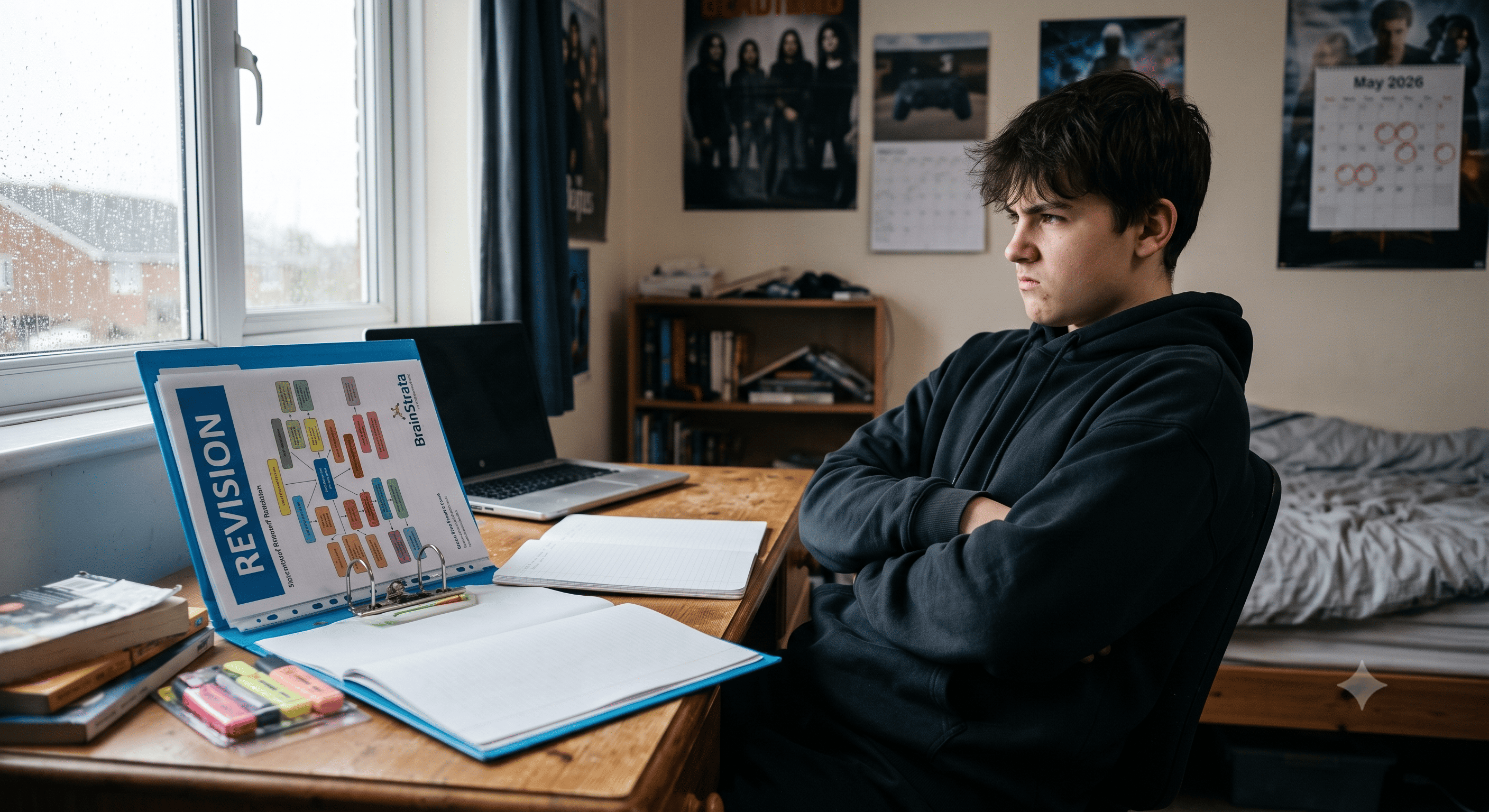
Half past seven on a Tuesday. The mocks are five weeks away. The revision guide has sat on the kitchen table since Sunday, exactly where it was put down, spine still uncreased.
You ask the question you've asked most evenings this week. Shouldn't you be revising? The answer doesn't arrive as words. It arrives as a door closing slightly harder than it needs to, and a silence that settles over the rest of the evening.
If some version of this is playing out in your house most nights, you are not failing as a parent, and your child is not being deliberately difficult. Something specific is happening underneath the refusal. Once you can see what it is, the way through gets a lot less of a fight.
It's Not Just Your House
“Child refuses to revise” is one of the most searched phrases among UK parents of GCSE students, and for good reason. Exam pressure on this generation of teenagers has reached a level most parents didn't face at the same age. Young Minds' 2025 survey of GCSE and A Level students found that 63% struggled to cope in the lead up to and during their exams. Among that group, over half had trouble sleeping, and one in eight reported suicidal thoughts during exam season.
That is the backdrop every revision conversation is happening against, whether you can see it or not. A teenager who won't open a textbook isn't necessarily refusing to try. Often, they are refusing to add one more demand to a pile that already feels unmanageable.
Why Pushing Harder Usually Backfires
The instinct most parents reach for first is more pressure. A stricter timetable. A nightly check-in that turns into a nightly argument. Taking the phone away until the work is done.
These approaches share a flaw that isn't obvious until you look at the research. Self-determination theory, developed over more than two decades by psychologists Richard Ryan and Edward Deci, shows that motivation depends on three basic needs being met: a sense of autonomy, a sense of competence, and a sense of connection to the people asking things of you. When a parent responds to refusal with more control rather than more autonomy, all three needs come under pressure at once, and motivation tends to fall rather than rise.
This isn't just older theory still being recycled. A 2024 study of over 400 secondary school students found the same pattern holding in teenagers specifically: those who experienced their parents as autonomy-supportive showed stronger academic motivation, with the effect working through a greater sense of self-control and ownership over their own choices, not simply through feeling less nagged.
This doesn't mean structure is the enemy. It means the structure has to feel like it belongs to your child, not something imposed on them.
Try this instead of “have you done your revision yet”: “What's one thing you'd be willing to look at tonight, and how long do you want to give it?” |
What Actually Helps a Teenager Who's Refusing to Revise
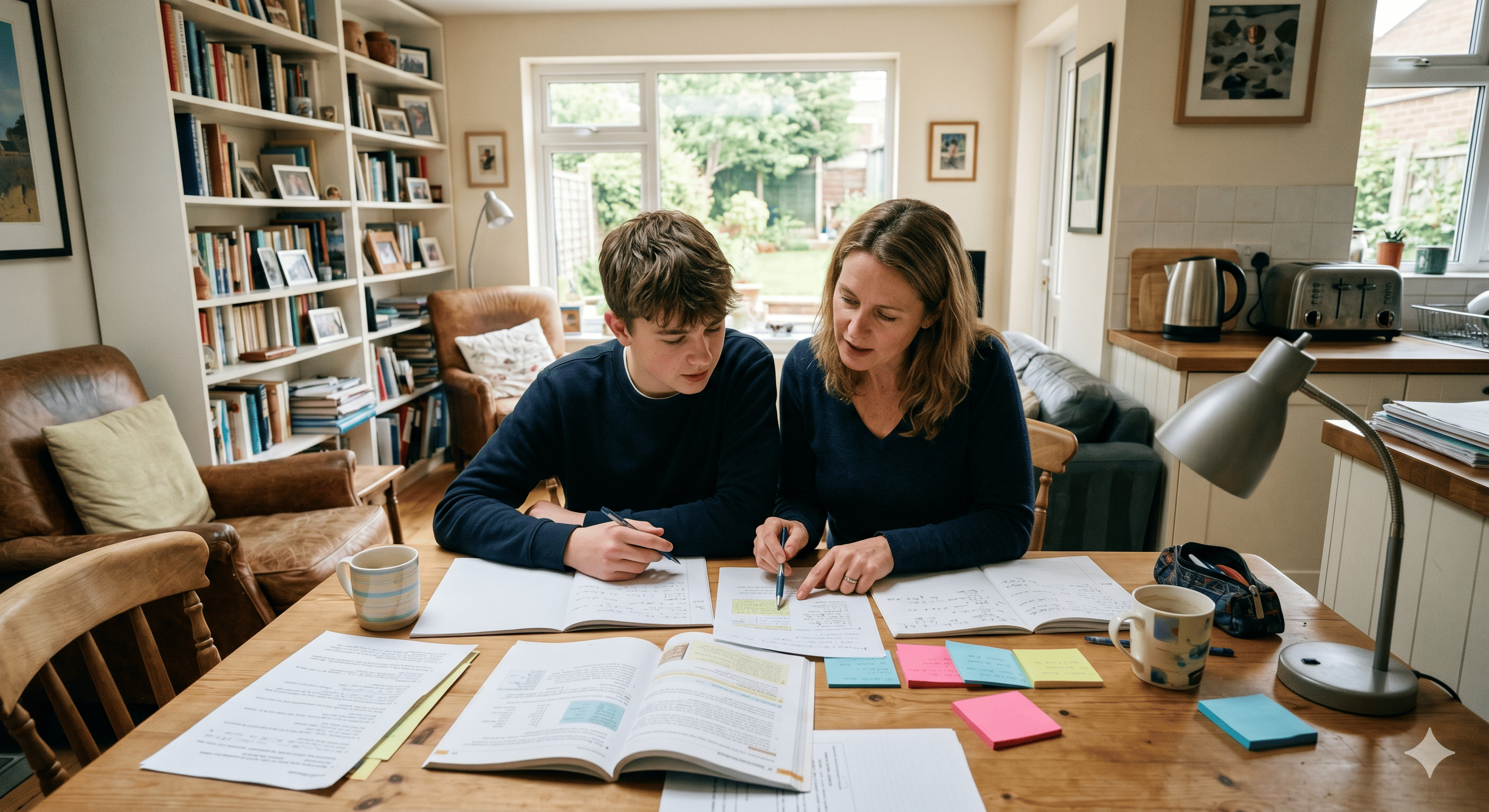
Hand back the decision. Ask what they'd be willing to look at, rather than telling them what to do. Offering a choice over subject, method, or timing, flashcards instead of notes, twenty minutes after dinner instead of straight after school, restores some of the control that nagging takes away. The content matters less than who chose it.
Shrink the ask. Most resistance is to the size of the task, not the subject itself. Fifteen focused minutes is far easier to start than an open-ended evening labelled “revision.” Agree a fixed, short amount of time in advance, and stick to it, even if it feels too short to matter.
Swap re-reading for retrieval. If a session does happen, steer it away from re-reading notes. Dunlosky and colleagues' 2013 review of study techniques rated re-reading as one of the least effective methods students use, despite it being the most popular. Testing yourself on the material, known as retrieval practice, produces stronger results, a finding that goes back to Roediger and Karpicke's original 2006 study and has since been confirmed at scale. A 2021 meta-analysis pooling 222 classroom studies and almost 50,000 students found regular low-stakes testing raised academic achievement by close to half a standard deviation, a bigger effect than most educational interventions manage. In practice, that means past paper questions, flashcards, or asking your child to explain a topic out loud rather than reading it silently.
Step out of the enforcer role. Nightly nagging turns revision into a relationship problem as much as an academic one. A single, low-stakes weekly check-in protects the relationship far better than nightly conflict, and keeps the conversation focused on progress rather than compliance.
Name what's underneath, gently. “I'm not doing it” sometimes means “I don't know where to start” or “I'm scared of finding out I'm behind.” Asking “is this about not wanting to, or not knowing where to start” can shift an entire conversation, because the two problems need completely different responses.
When Refusal Is About Something Else
Most revision refusal is ordinary teenage resistance to being told what to do, and it responds well to the approach above. It's worth knowing the difference between resistance and something more serious.
The figures above, one in eight GCSE and A Level students reporting suicidal thoughts during exam season, are a reminder that for a meaningful number of teenagers, what looks like stubbornness is closer to shutdown. Watch for refusal paired with withdrawal from friends, disrupted sleep, or a flat, “nothing matters” tone rather than ordinary frustration. If that's what you're seeing, the next step isn't a better revision technique. It's a conversation with your child's school, or your GP, about support beyond what's possible at the kitchen table.
Quick check: ordinary resistance, or something more? Resistance: frustrated, avoidant, still talks about friends and plans as normal. Something more: withdrawn, flat, sleep or appetite changing, a “nothing matters” tone. |
What to Do Tonight
You don't need to solve this in one conversation, and you don't need a perfect system by the weekend. Start small: one short session, chosen by your child, built around testing rather than rereading. Notice whether the resistance eases once the size and ownership of the task changes, because for most teenagers, it does.
This kind of self-directed approach, where a student plans, monitors, and adjusts their own revision rather than having it managed for them, sits at the centre of one of the strongest evidence bases in UK education. The Education Endowment Foundation's Teaching and Learning Toolkit rates metacognition and self-regulation approaches as worth an average of seven months' additional progress, a figure reaffirmed in its November 2025 guidance update.
For the evenings when you'd rather take yourself out of the negotiation entirely, having something structured that paces work into small sessions and uses retrieval-based practice, rather than another revision guide gathering dust, can take the daily back-and-forth off your plate. That's part of why BrainStrata is built the way it is.
Sources and further reading
Young Minds, Missing the Mark report (2025), survey data on GCSE and A Level student exam stress and mental health.
Education Endowment Foundation, Teaching and Learning Toolkit: Metacognition and Self-Regulation (updated guidance, November 2025).
Ryan, R. M., & Deci, E. L. (2000). Self-determination theory and the facilitation of intrinsic motivation, social development, and well-being. American Psychologist, 55(1), 68–78.
Çelik, O. (2024). Academic motivation in adolescents: the role of parental autonomy support, psychological needs satisfaction and self-control. Frontiers in Psychology, 15, Article 1384695.
Dunlosky, J., Rawson, K. A., Marsh, E. J., Nathan, M. J., & Willingham, D. T. (2013). Improving students' learning with effective learning techniques. Psychological Science in the Public Interest, 14(1), 4–58.
Roediger, H. L., & Karpicke, J. D. (2006). Test-enhanced learning. Psychological Science, 17(3), 249–255.
Yang, C., Luo, L., Vadillo, M. A., Yu, R., & Shanks, D. R. (2021). Testing (quizzing) boosts classroom learning: A systematic and meta-analytic review. Psychological Bulletin, 147(4), 399–435.
Frequently asked questions
Refusal is rarely about not caring. It's more often a response to a task that feels too big, too vague, or imposed from outside, especially against the backdrop of exam pressure that's well documented among UK GCSE students. Shrinking the task and handing back some choice over how and when it happens tends to do more than warnings about the importance of the exam.
Ready to boost your GCSE results?
Join thousands of students using BrainStrata's AI-powered personalised learning to master their KS3 and KS4 curriculum.